The first time I realized my childhood had been taken from me was not when I was forced to leave—but when I saw a stranger standing in it, smiling for a photo as if it had always been his.
When I was a child, around ten years old, I lived in my village near Nablus—a village that was never just a place, but a state of peace, a piece of the heart, and a refuge from the noise of the world.
There, homes were not silent walls, but living families. A single house would hold grandparents, parents, uncles, aunts, cousins, and grandchildren. Or neighboring houses would stand side by side like one extended family rooted in the land. Neighbors knew one another deeply; no doors truly separated them, and no distance divided them. They inherited the land and the stones from their ancestors until every stone carried a story and every corner held a memory.
Around each home was a small paradise—trees, birds, and life. We didn’t really know what it meant to “buy” things the way people do today. Vegetables came from the land, and fruits from the trees—grapes, oranges, apples, figs, and olives that filled the soul before they filled our homes.
I remember my grandmother. Every four or five days, she would bake bread. In the mornings, the smell of fresh bread would wake me gently—not just from sleep, but from one world into another. I would run to her warmth, to that small corner that felt like an entire universe to me. The chirping of birds, the morning breeze, her gentle voice—these simple details gave each day a beginning full of calm, as if life itself were whispering: “You are safe.”
Peace was the rhythm of our days. We would meet at the door, smiling, and walk together to school—yet our minds were always somewhere else, planning what would come after. Each of us carried something from home: bread, tomatoes, olive oil and thyme, cucumbers—sometimes tea—as if we were preparing for a small adventure, a simple trip that meant everything to us.
The mountains were our open world. We ran freely, climbed, wandered through the woods, and swam in springs. There were no cameras to capture those moments, yet they are carved into our memory—alive and vivid, as if they happened yesterday.
What truly defined my village was safety. There were no Israeli settlements surrounding it, and that alone was a rare blessing. Despite the occasional Israeli jeeps and tanks passing through, and despite the presence of prisoners from our village, it held on to its quiet for years—as if resisting in silence.
But like every Palestinian story, pain eventually finds its way in.
A couple of years ago, everything changed.
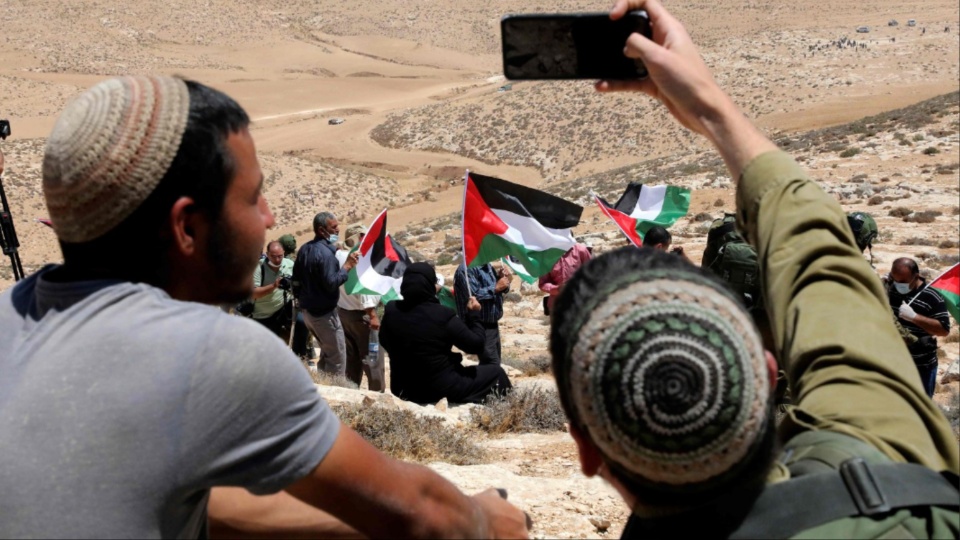
Israeli settlers came to one of the mountains in my village. They set up tents, stole livestock, and spread fear among the residents. They imposed themselves by force, claiming the land was theirs—that they were its “guardians,” while we were the strangers.
The news felt like a wound—terrifying to me, and to the people of my village who were not used to such darkness. Since then, the mountains have not been the same. We can no longer go there freely, breathe there, or live them as we once did.
I can no longer take my children there to show them the beauty that raised me—the beauty that shaped who I am.
And a few days ago, I saw a photo. A settler standing on one of those mountains, taking a selfie—in the very place that was once part of my childhood, my laughter, my dreams.
It was not just a photo. It was theft.
Theft of land, yes—but also theft of memory, of longing, of dreams.
I felt as though the place itself was grieving—as if every stone ached, every tree cried out, every flower protested: “This is not yours. You do not belong here.”
From a single image, it felt as if life was slowly leaving the place—fading, dimming, disappearing.
And the question echoes again and again:
Why?
Why must we live this?
And why are even our memories taken from us?
Yet one truth remains unchanged:
Injustice does not last, and truth cannot be erased.
The land may be taken—but what it has planted within us—love, belonging, memory—cannot be taken. Our stories live here, in every stone, every tree, every grain of soil. And if the land could speak, it would say: “Leave me to my people. Do not defile me with your presence.”
In the end, land may be taken, roads may be closed, and bodies may be kept away—but there is one thing that can never be taken: this belonging that lives within us like a soul.
We do not just remember the land. We live it. We carry it in our details, in our language, and in the stories we pass on to our children so the truth is never lost.
They may think their presence is enough to erase us. But they do not know that the land remembers its people—and that memory is stronger than any attempt to erase it.
One day, we will return—not only to reclaim what was taken, but to awaken life in every stone and tree. To say: We were here. We are still here. And we will always be here.
We Palestinians are not only the people of the land—we are its patience, its hope, its memory that never fades.
And I will return to that tree that is still waiting for me. I will embrace it, sit beneath its shade with my children, and tell them the stories I once lived here.
And then—
its branches will lean toward me,
wipe the tears of joy from my eyes,
and whisper:
“Welcome back… we have missed you.”
We hope you appreciated this article. At People’s World, we believe news and information should be free and accessible to all, but we need your help. Our journalism is free of corporate influence and paywalls because we are totally reader-supported. Only you, our readers and supporters, make this possible. If you enjoy reading People’s World and the stories we bring you, please support our work by donating or becoming a monthly sustainer today. Thank you!
CONTRIBUTOR