NEW YORK—AI has hit the AP: At least 120 U.S. newspeople, some of them longtime veterans of the Associated Press, the worldwide wire service, have received layoff notices as a result, with buyout offers—but with little notice to and no negotiations with their union.
AI—artificial intelligence—can be used for good or ill, but corporate executives are using it to guillotine people’s jobs, thus increasing company profits.
The cost, however, as critics on social media pointed out, is in reduced coverage at a time when news consumers need unbiased information more than ever before.
AP is a cooperative, owned by its clients. Newspapers founded it in the mid-1800s to exchange news with each other. But newspapers are shrinking and now provide only 10% of AP’s revenue, the co-op’s executives say. That’s down by 24% in the last four years.
The rest of its revenue, they claim, comes from the use of artificial intelligence, digital markets, the cloud, and visual and video stories.
“We’re not a newspaper company and haven’t been for quite some time,” Julie Pace, executive editor and senior vice president of the AP, told another online news service.
And AP’s cuts may be the tip of the AI iceberg when it comes to national layoffs, some financial analysts, led by Goldman Sachs, say.
Bosses pitch the layoffs as “reinvestment in software, cloud services and machine-run workflows,” the analysts add. Goldman said AI caused 5,000-10,000 layoffs per month nationwide last year, and forecast 16,000 monthly AI-caused layoffs this year.
“Reinvestment” is almost exactly the explanation AP’s executives gave for the planned layoffs of the U.S. staffers. Only they didn’t tell the AP staffers’ union local, the News Media Guild, in advance—much less bargain over the move. And that angers Guild leaders.
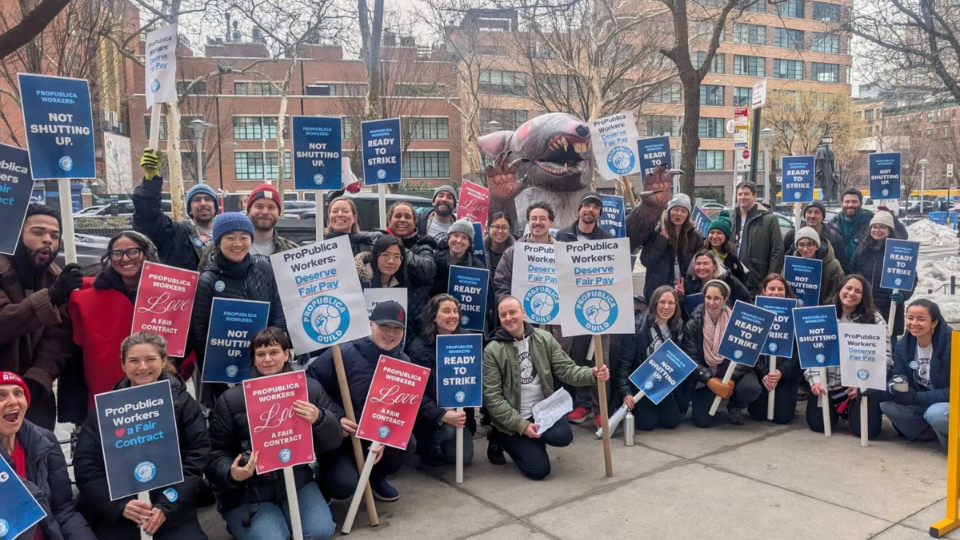
Journalists at AP aren’t the only ones threatened by bosses’ imposition of AI. The 150-person staff at ProPublica, the non-profit investigative newsroom that has won prizes for its exposés, recently voted 92%-8% to authorize a strike over working conditions and the AI menace to news-gathering. The strike began at 9 a.m., April 7.

And on April 6, NewsGuild President Jon Schleuss sent a follow-up letter on AI to ProPublica’s management. The Guild also filed an unfair labor practices complaint with the National Labor Relations Board (NLRB) regarding ProPublica’s plan. “ProPublica is obligated to bargain with us on any across-the-board policies or changes, and they failed to do so,” the complaint says.
The larger NewsGuild, a CWA sector, includes the locals that represent the AP workers and the ProPublica staffers, too.
ProPublica’s bosses need to agree to “a contract with strong guardrails around the use of AI,” Schleuss said in his letter.
“Our world needs more investigative journalism in the public interest. Continuing ProPublica’s mission will require a strong, fair collective bargaining agreement that uplifts journalistic integrity.”
“And that means ProPublica needs to have contractual language prohibiting any potential for artificial intelligence to replace journalists and other workers who make ProPublica the important publication it is today,” Schleuss wrote.
In an email sent on April 7 to fellow union members and supporters announcing the 24-hour unfair labor practice strike by ProPublica staff, Schleuss noted that, “Our 140 members at the nonprofit news organization have bargained for more than two years while management has dragged its feet.”
AP said it’s laying off the U.S. staffers, with buyouts, because the wire service “is re-engineering itself to serve its growing market of marketing, video, digital and online customers, since its traditional market, newspapers, is shrinking.”
Two major remaining newspaper chains, Gannett and McClatchy, dropped AP in 2024. A third chain, Lee, which owns the Buffalo Evening News, the St. Louis Post-Dispatch and the Richmond Times-Dispatch, among other papers, wants to dump AP by the end of this year. Guild locals represent the workers at all three papers.
“The AP employs hundreds of talented journalists who are willing and able to adjust to the changing media landscape,” the News Media Guild’s executive council said in a statement defending its AP members. “However, the company refuses to offer them appropriate training and tools.
“Instead, AP continues to get rid of experienced staff and flirt with artificial intelligence—ignoring the opportunity to differentiate AP news stories as ones that are and always will be created by human journalists.”
The News Media Guild also stated managers gave it “a few minutes’ notice before they pushed the ‘send’ button” on an e-mail to AP’s worldwide staff about the planned layoffs and buyouts.”
And the union said AP ignored a Guild request to bargain over artificial intelligence. The AP did not respond to that claim or the layoff numbers, which would affect at least 5% of AP’s U.S. staff, and leave many beats, especially in the 50 states, uncovered.
“AP needs to listen to its workers,” the News Media Guild’s executive council continued. “Success in navigating journalism headwinds involves honesty and forthright discussion with its workers, through their union.”
Instead, the News Media Guild added AP’s announcement shows the wire service “offered no coherent vision of where it is headed and who its customers are. Instead, it appears to be flailing and desperate, chasing trends that will soon disappear.”
AP had no immediate response to the News Media Guild’s comments, or its nose count of how many journalists received buyout offers via e-mail.
Chauncey K. Robinson contributed material for this story.
We hope you appreciated this article. At People’s World, we believe news and information should be free and accessible to all, but we need your help. Our journalism is free of corporate influence and paywalls because we are totally reader-supported. Only you, our readers and supporters, make this possible. If you enjoy reading People’s World and the stories we bring you, please support our work by donating or becoming a monthly sustainer today. Thank you!
CONTRIBUTOR