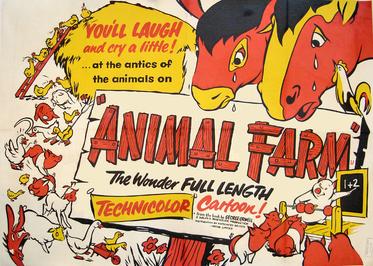
A “fun” fact about the 1954 film Animal Farm, based on the novel by George Orwell, is that it was funded by the CIA (the same was true of the later screen adaptation of his 1984). The spy agency’s idea was to take the popular novel and its themes of workers’ revolution, communism, capitalism, and authoritarianism, and make it lean more towards an anti-communist, anti-Soviet stance.
A novel that famously exemplified the idea that “absolute power corrupts absolutely” became an animated film that really seemed to say “a workers’ revolution can’t really work because some of the workers will become corrupt leaders absolutely.” This, of course, misses the point of Orwell’s known issues with both capitalism and the Soviet Union under Joseph Stalin’s rule.
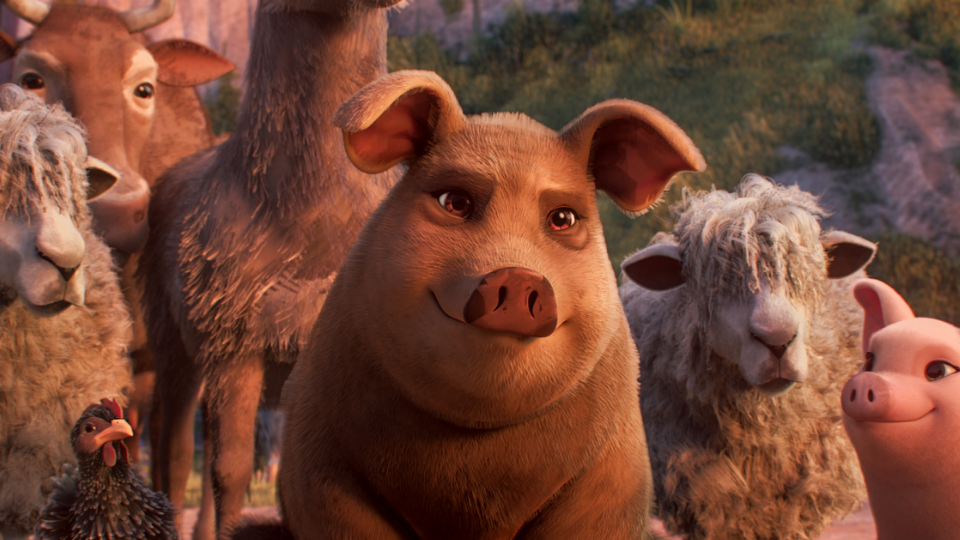
The latest adaptation, directed by Andy Serkis, seemingly returns to the original ending/theme— that corrupt leadership is bad under any system. Yet, because so much from the novel feels missing, glossed over, or completely changed in order to use original (and somewhat unnecessary) characters, the result makes for an oversimplified interpretation of Orwell’s work, with some entertaining stops along the way. It’s not a bad film, but it fails to sufficiently grapple with the complex concepts presented in Orwell’s novel, instead settling for an almost Pixar/Disney-fied interpretation that tries to appeal to both child viewers and adults, skewing a bit more towards children.
Directed by Andy Serkis, Animal Farm is a 2026 animated comedy-adventure film written by Nicholas Stoller, based on Orwell’s 1945 novella. Orwell’s novel is considered a satirical, allegorical dystopian story. It follows the revolt of farm animals against their repressive human owners. The animals take over the farm and decree new laws, a major one being that “all animals are equal.’ This law is soon put to the test as some of the pigs—led by one named Napoleon (representing Stalin)—begin to consolidate power for themselves, ultimately corrupting the animals’ rebellion and seemingly becoming no different from their former human oppressors. In Serkis’ adaptation, the core of the plot remains, but a new titular character is introduced: a young pig named Lucky. Lucky is a smart yet easily impressionable pig who finds himself torn between the trappings of power that Napoleon offers and his solidarity with the rest of the farm animals.
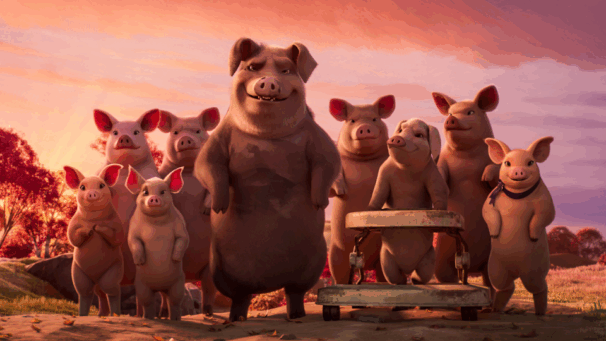

One of the major strengths of Animal Farm is its voice acting. Talents like Seth Rogen, Gaten Matarazzo, Steve Buscemi, Glenn Close, Laverne Cox, Woody Harrelson, Kathleen Turner, and Iman Vellani deliver solid performances in their respective roles. Major standouts include Turner as the wise and somewhat nihilistic donkey Benjamin, and Close as the super-rich capitalist human boss, Freida Pilkington.
The moments of humor land well enough, but they seem to come at the expense of letting more serious moments in the film have room to breathe with the audience. It’s almost like the filmmakers don’t trust child and adult viewers to handle harsher concepts long enough to really grasp what is happening on screen. This makes for pacing that feels way too fast, with far more crammed into the plot happenings than needed.
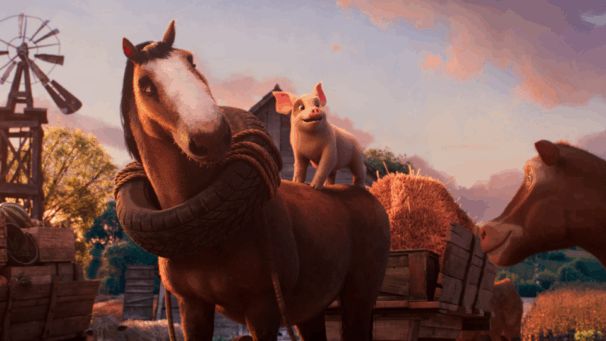
Then there is the issue of Lucky. The character, played with great heart and energy by Gaten Matarazzo, is likable enough, but in a story where the characters are meant to be symbols of various roles in the class struggle or actual historic figures, it’s hard to grasp exactly who Lucky is supposed to represent. At best, Lucky is a device to make the story more relatable to younger viewers, giving them someone to empathize with. At worst, Lucky could be seen as a way to say that some leaders who become corrupt aren’t really so, but have simply “lost their way”—which feels a bit of a cop out.
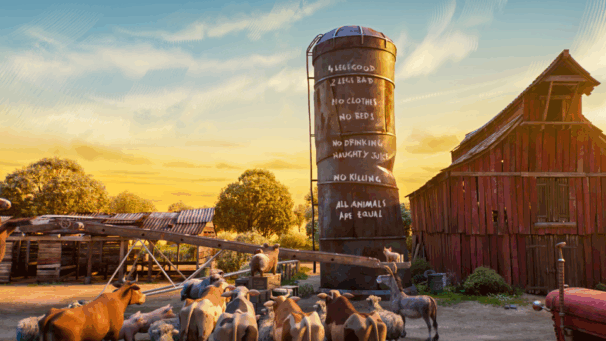
Also, because so much emphasis is placed on Lucky’s awakening to Napoleon’s corruption, the collective journey of the animal workers feels secondary—when it really should be front and center, as it’s the strongest element of the story. In the novel, the animals, together, come to the realization that the corrupt pigs are no different than their human oppressors. In this film, it is Lucky who gets that moment by himself. Thus, what should have been a powerful collective moment of class consciousness becomes an individualistic one.
Perhaps a kinder view of Lucky might see him as a worker who ultimately resists the trappings of corruption, understanding that collectivity and community are the best road forward for humanity…er, I mean, animals. This is a pretty good and relevant message, given that recent polling shows that many millennials and younger generations no longer see capitalism as the best system to live under. While a growing number of people in the United States view socialism favorably, capitalism’s popularity is waning.
But what does Animal Farm 2026 think about these different systems? Well, that’s hard to tell.
In creating a more modern-day retelling, many of the direct parallels with the Soviet Union under Stalin that appeared in the novel seem to get left on the cutting-room floor. This isn’t actually a bad thing, because with the Animal Revolution no longer being a direct representation of the 1917 Bolshevik Revolution under Lenin, which ultimately came under the rule of Stalin following Lenin’s death, there’s no real sense that what the animals are doing after they revolt from the humans is some failed experiment in communism.
Instead, the film leans heavily on the failings of blindly following propaganda, never questioning those in leadership, and sowing inequality in society. It doesn’t necessarily take a stance on whether one system is worse than the other, just that any system or leadership that exploits and oppresses its workers for the benefit of a few is bad. Which is surprising, because the tagline this critic received in a press release for the film described it as “fulfilling Orwell’s warning about the dangers of communism.” But…that’s not at all what really comes through in the film.
Perhaps that has to do with the gutting of overt historical references to Stalin’s Soviet Union, but the comparisons between systems don’t come through. If anything, Napoleon’s corruption seems unrelated to the trope that attempts to build a communist society inevitably results in corrupt leadership. Instead, it seems to center on the simpler observation that the formerly oppressed emulate their oppressors if they gain power themselves. And Napoleon and the pigs certainly do this, as they mimic human mannerisms and exploit the other animals.
Some of Orwell’s fans on the left have long argued he wasn’t necessarily anti-communist, but rather anti-Stalin—especially given his direct attacks on the Soviet leader and his supporters, sparked by his experiences in the Spanish Civil War fighting alongside the Trotskyist POUM faction. His critics, however, point to the fact that Orwell “named names” in 1949, providing the British Foreign Office with a list of those he thought to be communists or communist sympathizers to be blacklisted for writing work with the government.
Regardless, the Animal Farm novel counterposed a very specific system (Stalin’s Soviet Union) against capitalism. Since Animal Farm 2026 seems to remove or at least downplay that specific comparison, and our political terrain is somewhat different from the 1950s, there’s an opportunity to look at this interpretation with fresh eyes. Art, after all, doesn’t exist in a vacuum and is influenced by the society it reflects.
We live in a time where it is very clear that capitalism doesn’t work for the 99%. No amount of propaganda can hide the reality that workers in the United States are going through an affordability crisis as billionaires somehow get richer. It seems ridiculous, then, to present a film that says “but communism” when recent generations are very well aware that it’s capitalism that is the true oppressive system. Luckily, Animal Farm 2026 doesn’t end up doing that (although the tagline makes it seem like it wanted to) and instead focuses on corrupt leadership in general.
If nothing else, this new interpretation of Animal Farm will no doubt spark viewers across generations to dive deeper into the 1954 film and the novella that started it all, not to mention the history it’s connected to. Hopefully, they will be inspired to study the Bolshevik Revolution, the world during that time, and come to their own conclusions about what it all meant, and still means for our world today.
People’s World is in the midst of its annual fund drive, trying to raise $140,000 by May Day. To support working-class journalism, please consider make a donation or become a monthly sustainer. Thank you.
CONTRIBUTOR