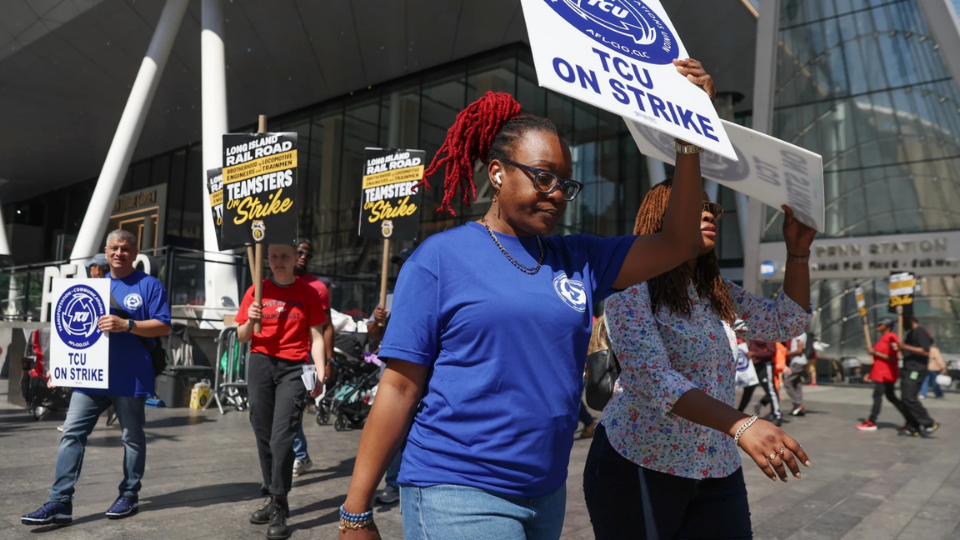
NEW YORK—A tentative four-year contract, worked out between five rail unions and Long Island Rail Road (LIRR) management, ended a three-day strike by 3,500 LIRR workers—half of its employees—on May 18. It was the first LIRR strike in 32 years.
Full service on the nation’s largest and busiest commuter rail system will resume today, said Gov. Kathy Hochul, D-N.Y., who shuttled between the two sides during their final bargaining session into the wee hours of the night.
It can take a while to return the trains to their yards and check them over before sending them out again to carry commuters both ways 24/7 from the farthest ends of Long Island all the way into Penn Station and Grand Central Station in Manhattan, and two key intermediate terminals in Brooklyn and Queens.
Estimates of daily LIRR ridership range up to 350,000, with the American Public Transit Association reporting 336,500 in the fourth quarter of last year
The tentative agreement “delivers raises for workers while protecting riders and taxpayers,” Hochul tweeted on X. Union leaders withheld details until they could share them with their members.
But Kevin Sexton, vice president of the Brotherhood of Locomotive Engineers and Trainmen/ Teamsters, said his union and bargainers for the four other unions representing the workers believe it’s a fair deal. The others are the Railway Signalmen, the Transportation Communications Union/IAM, the Electrical Workers, and the Machinists.
“We are looking forward to our members getting back to work doing what they do best, which is serving the region,” Sexton told a news conference.
During the weekend of the strike, May 15-16, the rail workers picketed major LIRR rail hubs. Their signs read “No contract, No work” and “Equal work. Equal pay.”
The two sides had actually agreed on wage hikes of 3% retroactive to June 16, 2023, 3% retroactive to June 16, 2024, and 3% retroactive to June 16, 2025, a Presidential Emergency Board reported. The board, the second named by Republican Donald Trump under provisions of the Railway Labor Act, recommended a 4.5% hike on July 16, 2026. LIRR bosses balked.
The RLA governs labor-management relations on railroads and airlines. It includes mandated federal mediation if both sides can’t agree. And only if that doesn’t work and long cooling-off periods expire, can the workers strike, and the bosses lock them out.
The unions also said 4.5% in the fourth year of the pact was too little to make up what the workers would lose to inflation, even with a $3,000 lump sum ratification payment upon ratification this year.
The LIRR said it was too much, protesting that the combined raises would produce an 8% commuter fare hike. Hochul only said both sides had agreed on a fourth-year figure, but not what it would be.
The LIRR also pushed for work rule changes to achieve “enhanced productivity,” but the emergency board’s report to Trump said the carrier wasn’t specific and didn’t prove the need anyway.
During the full weekend of the strike, May 16-17, Hochul, preparing commuters for the first full workday afterward, urged LIRR riders to find alternatives to the trains, especially telecommuting. She knew well that New York City’s incoming expressways from Long Island are miles-long parking lots during rush hour, even when the LIRR is running 24/7.
The LIRR bosses chartered shuttle buses to ferry riders, free, to key subway stations, but admitted they couldn’t find enough buses to handle everybody. For whatever reason, the buses carried only 12,300 inbound riders on Monday morning, May 18, news reports said. AmNY, a public radio station, reported that union leaders said the bus drivers, for private firms such as Blue Bird, crossed picket lines.
The rail unions drew strong state, city, and federal labor support. AFL-CIO Transportation Trades Department Greg Regan and Secretary-Treasurer Shari Semelsberger said in a statement that the strike “is about fairness, a living wage, and recognition of the essential work of LIRR employees.
“Let’s be clear: These unions have bargained in good faith and followed the legal processes in place. After two Presidential Emergency Boards ruled in favor of the bargaining coalition’s demands, the Metropolitan Transportation Authority”—which oversees the LIRR—“refused to cooperate.”
“The resulting significant travel delays and disruptions” on the nation’s #1 commuter rail system show how vital the LIRR workers are, the duo said.
We hope you appreciated this article. At People’s World, we believe news and information should be free and accessible to all, but we need your help. Our journalism is free of corporate influence and paywalls because we are totally reader-supported. Only you, our readers and supporters, make this possible. If you enjoy reading People’s World and the stories we bring you, please support our work by donating or becoming a monthly sustainer today. Thank you!
CONTRIBUTOR