LOS ANGELES—When California voters go to the polls on June 2, if they already haven’t mailed in their votes, they’ll confront butterfly ballots and contested—and often bitter—races for the governorship, the Los Angeles mayoralty, and congressional seats, plus dozens of bond referendums, and even two term limit initiatives in San Francisco.
And that’s not even counting a separate drive to put a one-year “billionaires tax” up for a citizens’ referendum in November.
It’s enough to make your head spin, which is why analysts predict a light turnout of only committed partisans from both parties, validated by the fact that, as of the end of May, only 13% of the requested mailed-out ballots had been mailed back in. That’s a lower percentage than in prior mid-term elections.
“A lot of us have been holding onto our ballots,” until the very end of the campaign, says veteran San Diego activist Janice Rothstein. They’re hoping to see a trend for a particular progressive candidate.
Which hasn’t stopped either record spending in the Golden State, led by Democratic gubernatorial hopeful multimillionaire progressive Tom Steyer, or bitter rhetoric, especially from Los Angeles Republican mayoral hopeful Spencer Pratt. Listen to “reality” television show host Pratt on Fox and Friends, and you’ll think you’re hearing Donald Trump’s nasty blame of Democrats for every problem.
Here, then, is the California primary chaos, starting with the ballots themselves:
The butterfly ballot and the Governor’s race
To get an idea of the confusion, the California Secretary of State certified 61 people for the gubernatorial race, but later reports said the secretary’s office cut it to ten. The analysts point out that all 61 may still be on the ballot. News coverage concentrated on the top ten—six Democrats, two other well-known Democrats who dropped out, and two Republicans. The rest are independents and minor-party candidates.
California’s other unusual feature is that the top two finishers, regardless of party, advance to the November 3 general election. That worries Democrats in deep-blue California.
They feared the six current active Democrats—veteran officeholder Xavier Becerra, progressive multimillionaire Tom Steyer, former Rep. Katie Porter, former Los Angeles Mayor Anthony Villaraigosa, Superintendent of Public Instruction Tony Thurmond, and San Jose Mayor Matt Mahan—could so split the Democratic electorate that Republicans Fox News commentator Steve Hilton and Riverside County Sheriff Chad Bianco would finish one-two.

That may not occur. Two notable Democrats left the race: Former Rep. Eric Swalwell dropped out and quit Congress after credible sexual assault allegations surfaced. Former State Controller Betty Yee’s grass-roots campaign couldn’t overcome the need for massive money. She withdrew and endorsed Steyer.
Hilton has pulled ahead among likely GOP voters, who make up about a fourth of the total electorate. The final opinion poll, from Emerson College and the California Institute of Politics, finished May 30, gives Becerra 27.5%, Steyer 22.3%, Hilton 21%, Blanco 11.5%, and Mahan and Porter 5% each. The rest of the voters go for other candidates or are undecided.
News reports and analysts report that the 61 are split into two columns, with Becerra atop one column of 31 and Steyer near the bottom of the other, which has 30. Past studies show that in a low-information, high-turnout election, ballot position, especially on top, matters. This election may well be the opposite, analysts told People’s World.
That also makes group endorsements and GOTV efforts especially important. Studies show voters are more likely to pay attention to backers who are trusted sources of information. For the Democrats, that’s organized labor. The state party is in disarray.
The California AFL-CIO has stayed neutral. California’s Service Employees endorsed Swalwell, but pulled its endorsement when the sexual abuse allegations surfaced. Teamsters Joint Councils 7 (Northern California) and 42 (Southern California) endorsed Porter. AFSCME Local 3299 endorsed Steyer.
The California Nurses Association/National Nurses United endorsed Steyer. So did the California Teachers Association/AFT and the California Education Association/NEA. The Progressive Democrats of America supported Yee.
Of the others, Villaraigosa’s campaign has failed to get off the ground, despite what was a strong base—but apparently isn’t any more—among Latino voters in Los Angeles. He’s been strongly linked to that community for a quarter of a century. Mahan has been painted as a captive of corporate interests for taking campaign finance money from Chevron and other business lobbies.
Swalwell’s withdrawal saw the bulk of his support shift over to Becerra, who, as a “safe” candidate of the party elite, barely finished first at the Democratic state convention, ahead of Yee. Thurmond, the sole African-American in the race, is a low-key candidate drowned out in the verbal wars.
Longtime Latino activist and organizer Rosalio Munoz reports that Becerra has a deep and long-lasting well of support among Latinos in Los Angeles County, the state’s most populous.
It goes all the way back to when Becerra joined grape boycott marches and similar pro-worker actions as a young rising lawmaker, and when he campaigned strongly against GOP Gov. Pete Wilson’s anti-Latino and anti-immigrant Prop 187. That proved to be a turning point in state politics. It energized the Latino electorate, whose votes have converted California over subsequent years from being purple to the current deep blue.
While other candidates call Becerra the middle-of-the-road or the “safe” candidate, “I know he can be influenced to take the union side,” as he has in the past, Munoz adds.
One Munoz example: “The Olympics,” which Los Angeles will help host in 2028, “will be run by corporations,” and Becerra defied them by working for Unite HERE Local 11’s successful campaign to raise the minimum wage for hospitality workers’ pay to $30/hour by the time the games roll around.
Most of those hospitality workers are people of color, and L.A. is 45% Hispanic.
The candidates are trying to differentiate themselves on issues. Becerra stresses his record as state Attorney General in fighting right-wing GOP President Donald Trump’s regime. Steyer strongly supports Medicare for All—a top cause of National Nurses United and other unions—while Becerra, on his campaign website, calls for strengthening the Affordable Care Act.
And Munoz notes Steyer was the sole gubernatorial hopeful so far to criticize California’s mid-term congressional redistricting push. More than 60% of state voters approved it in a referendum. It’s expected to yield at least five more Democratic-held congressional seats, offsetting deep-red Texas’s elimination—at Trump’s demand—of five Democratic seats there.
Porter refuses corporate PAC money. Steyer, a former hedge fund manager who has never held elected office, has spent $200 million of his own money on the campaign. He says doing so makes him independent of those wealthy interests. He was also the only candidate from either party to support the billionaires’ tax.
But the other candidates jumped on Steyer’s hedge fund’s investments, 14-15 years ago, in a big private prison firm. “He’s renounced it,” says Janice Rothstein, the San Diego activist.
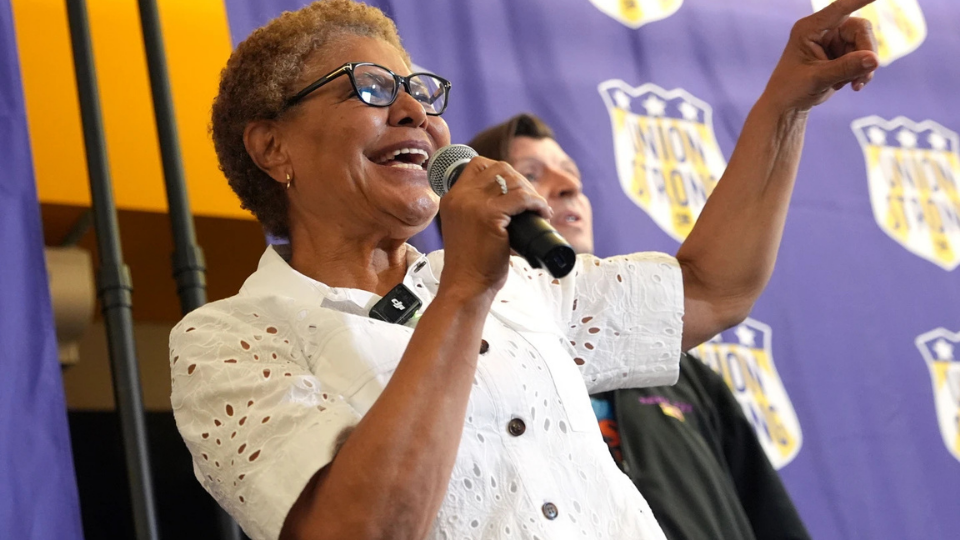
In the nation’s second-largest city, Los Angeles Mayor Karen Bass has a fight on her hands. Veteran analyst Richard Green says wealthy Republicans in the San Fernando Valley and the city’s West Side are providing the bulk of the money for right-wing talk show host Spencer Pratt. His rhetoric blaming Democrats for virtually every ill besetting the city and the country makes Donald Trump look mild.
And L.A. unions are virtually unanimous in backing Bass, who has emphasized housing, education funding, and combating the city’s homelessness problem, among other issues.
The latest opinion polls show Bass with 26% of the vote, Democratic Socialist City Councilmember Nithya Raman with 25%, and Pratt with 20%. There are 13 other candidates in the race.
That’s where the ground game may be all-important, Rothstein reports—and that’s where Bass has the edge. Los Angeles County unions have a nationwide reputation for successfully mobilizing members and voters.
Bass touts reductions in crime and homelessness and reordering city priorities, as well as her union support. But analyst Green says last year’s Palisades fire “continues to haunt her.” Bass must answer why the worst-ever blaze overwhelmed the Los Angeles Fire Department so quickly.
Trump endorsed Pratt two months ago in a one-sentence statement. Five days before the primary, term-limited Gov. Gavin Newsom (D) endorsed Bass. But that’s all. Will Newsom have coattails? Unlikely.
“The work Karen Bass is doing in Los Angeles is making our entire state stronger, with an 18% decline in homelessness while it grew nationally, historic drops in violent crime, boosting film production in LA, and protecting our communities against ICE. She has my full support for reelection,” Newsom said.
“I have deep respect for Mayor Bass,” Raman, who is running to Bass’s left, adds. “We’ve worked closely together on my biggest priorities and her biggest priorities, and there’s significant alignment there. But over the last few months in particular, I’ve really begun to feel like unless we have some big changes in how we do things in Los Angeles, that the things we count on are not going to function anymore.” But her own organization, the Democratic Socialists of America, is staying neutral.
Pratt, a talk show host, is nasty.
“The people I’m surging with are the people having to step over the drug addicts and step into human poop to get their $20 matcha,” he told the right-wing network’s Fox and Friends show earlier this year. “Those are the people that I’m surging the moms across Los Angeles who have to use their strollers around fentanyl, needles, and naked drug-addict zombies with machetes that maybe will chop a limb off.”
“Pratt is way out of his league and putting up AI (artificial intelligence) slop in his ads,” Green notes. And the Bass campaign team said, “Spencer is just mad that his supporters are just AI cartoons and we have real Angelenos.”
Upheaval in the U.S. House delegation
The new California congressional districts set off pitched battles all over the state, according to both the analysts and the Progressive Democrats of America. At least five GOP seats were drawn to switch to the Democrats. Swalwell resigned. Former U.S. House Speaker Nancy Pelosi of San Francisco retired from her ultra-Democratic district.
And activist, anti-war, and pro-Medicare-for-All Sacramento City Councilwoman Mai Vang is challenging 18-year incumbent Doris Matsui for her seat. It’s a generational battle. Matsui, 81, succeeded her husband, who held the seat for 30 years.
That’s a generational fight as well as one of different priorities. Matsui survived a Utah internment camp for Japanese-Americans during World War II, and says the current ICE roundups, sweeps, deportations, and camps of migrants remind her of that. Vang, 41, one of 16 children from a Hmong refugee family from Laos, is also an advocate for communities of color and founded GOTV organizations.
She’s also a passionate advocate of programs Trump has cut, such as food stamps. Her family needed them to survive when she was young. And the Salvation Army provided other needs.
“The most-interesting seats” in Northern California are CD3”—a Sacramento-based seat—“and the Pelosi seat,” says Green. There, the Progressive Democrats and Pelosi are supporting city supervisor (councilmember) Connie Chan. She faces millionaire Robert Weiner, who’s made housing his big issue.
“Progressives know her (Chan) to be an across-the-board progressive, and there haven’t been as many of those from California as there used to be,” says Alan Minsky, a Californian and national chair of the Progressive Democrats of America, whose goal is to take over the party from within and push it in a progressive direction and away from corporate interests.
Chan “is backed by all of the left and labor organizations” and has supported a cease-fire in Gaza, says POA’s San Francisco co-chair, Dr. Haemin Cho. “My people” in San Francisco’s Chinatown “cannot afford health care or child care or to put food on the table,” says Chan in a video announcing her run.
Analyst Green predicts Pelosi’s endorsement will swing great weight in the district.
A third candidate in that race is Saikat Chakrabarti, Rep. Alexandria Ocasio-Cortez’s former chief of staff, who left that job after alienating the rest of the staff and on the outs with her. Left unsaid were the times AOC and Pelosi didn’t see eye-to-eye either, especially when Pelosi said—on national TV—that she pigeonholed Medicare For All because voting for it would have cost House seats.
Physician Ami Bera (D) holds a second Sacramento-based seat, which, however, stretches all the way to Lake Tahoe on the Nevada border. Chris Bennett, a 2013 West Point graduate and military veteran, who told PDA he became “radicalized” by both listening to Independent Sen. Bernie Sanders and by the war in Iraq, is challenging Bera.
“Why did we go to war in Iraq and Afghanistan rather than paying for health care?” says the youthful Bennett, who served in Korea. “I preferred his positions. It was like crossing the Rubicon…We have very, very terrible policy.”
A notable GOP incumbent among the five districts switched to Democratic tilts is David Valadao, one of the last two Republicans who voted to impeach Trump. His 22nd district was totally redrawn, and he won the seat in 2024 by less than 2%. “It’s a winnable seat because the district has been moved to the left” by the redistricting, says PDA national chair Minsky.
Richard Green, Janice Rothstein, and Rosalio Munoz contributed material for this story.
We hope you appreciated this article. At People’s World, we believe news and information should be free and accessible to all, but we need your help. Our journalism is free of corporate influence and paywalls because we are totally reader-supported. Only you, our readers and supporters, make this possible. If you enjoy reading People’s World and the stories we bring you, please support our work by donating or becoming a monthly sustainer today. Thank you!
CONTRIBUTOR