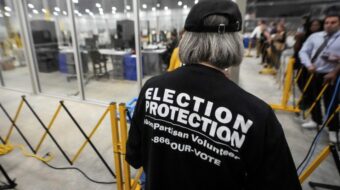
Primary elections on Tuesday, June 2, reflected the determination of the nation’s anti-MAGA forces to strike a blow against the authoritarian Trump regime in races ranging from the U.S. Senate and House of Representatives to state governorships, mayoralty contests, and local legislative posts.
One of the best turnouts by “progressive” voters happened in Los Angeles, where Democratic incumbent Karen Bass garnered 37% of the vote, and one of the two main challengers, Democratic Socialist city council member Nithya Raman, got 21%, giving progressives a clear majority, assuming Raman’s voters rally behind Bass in November.
The vote this week also reflected the possibility that President Trump could be losing his grip on what is an ever-shrinking extreme right-wing voter base. In a Republican U.S. Senate race in Iowa, for the first time, President Trump’s choice in a GOP primary contest failed to win the election.
Primary battles
In the California governor’s race, Democratic candidate Xavier Becerra finished just slightly behind right-wing Republican Steve Hilton. “Progressive” billionaire Tom Steyer, who backs Medicare-for-All, came in third. He hasn’t conceded, and if his vote and Becerra’s were combined in the now-necessary runoff, the Republican would go down to defeat. Becerra got 26% to 28% for Republican Hilton and 20% for Democrat Steyer. The final vote could take days to tally.
Progressive San Francisco city council member Connie Chan finished second to State Sen. Scott Weiner, who spent $10 million in the race to succeed retiring former House Speaker Nancy Pelosi (D). She campaigned for Chan in the deep-blue 11th District, and the two Democrats advanced to the fall election.
The two top finishers advance to the November election under the Golden State’s “jungle primary” system, where all candidates from both parties run on a single ballot, and the top two keep going. So in the L.A. mayor’s race, for example, Bass will face the second-place finisher, far-right talk show host Spencer Pratt, whose rhetoric is like Trump’s, only more incendiary.
The flip side of that came in the Sacramento-based 7th Congressional District. There, Sacramento City Councillor Mai Vang, 41, Republican Zacariah Wooden, and others challenged 81-year-old 18-term incumbent Doris Matsui, who led with 30.7%. She’s the establishment candidate, having succeeded her husband Robert in that district. Yang had 26% and Wooden 24%, but that order could change as mail-in ballots are counted.
And in California’s new 22nd District, reconfigured after anti-Trump redistricting, GOP incumbent David Valadao—one of the last two sitting Republicans who voted in 2021 to impeach Trump—won just over 40%. Two Democrats split the rest, with progressive Randy Villegas finishing second. Villegas will face Valadao in a seat the party has put on its “red-to-blue” list.
In Iowa, longtime activist Joe Henry reported that VoteVets, a PAC allied with Senate Minority Leader Charles Schumer, D-N.Y., spent $10 million supporting wheelchair-bound war veteran Josh Turek. He beat insurgent Zach Walls, who openly said he would not support Schumer—whom many progressives consider weak—for another leadership term.
“Turek’s message was about the struggles he went through” after being injured in war, said Henry. He also appealed to Iowa’s growing Latino/Latina population, as his spouse is Latina and he speaks Spanish. “But his positions” on issues “were pretty much the same as Walls’,” Henry added.
In Iowa, the hope is that a unified fight now to elect Turek will help shift control of the U.S. Senate out of the MAGA column.
With campaign cash playing a major role in so many races, there was at least one case where money didn’t talk, but progressive stands and shoe leather did, Henry said: A Democratic primary race for a county supervisor’s seat in Polk County, Iowa, which includes the state capital of Des Moines.
There, “moderate” Joe Gatto outspent progressive Heather Jones-Brown, Henry reported. The dollar margin was $180,000 to $12,000. Jones-Brown had the ground game and “was walking the neighborhoods,” Henry reported. Jones-Brown won, 3,124-3,082.
New Jersey had a number of key congressional primaries. In the 12th District, where Democratic Rep. Bonnie Watson-Coleman is retiring, 12 Democrats competed for the party’s nod. Watson-Coleman—along with Reps. Robert Menendez, Jr. and LaMonica McIver, Sen. Andy Kim, and Newark Mayor Ras Baraka—have led the crusade against ICE’s huge detention center in Delaney Hall, reports veteran activist Lee Dlugin.
They’ve battled arrests, pepper spray, and other attempts to stop them from scrutinizing conditions in the facility. The Trump administration is so incensed against McIver that it’s trying her on trumped-up assault charges, and she’s had to spend $1 million on legal fees, Dlugin says.
The Democratic winner in the 12th District race was Army veteran and surgeon Dr. Adam Hamawy, “who has a very good position on immigration, defending Medicare, and stopping the genocide in Gaza,” says Dlugin.
She also hailed the win of incumbent Congresswoman Analilia Mejia in the 11th District, who took 81.5% of the Democratic vote and will go up against Joe Hathaway, who was unchallenged in the Republican primary. Mejia, who is affiliated with the Center for Popular Democracy, “comes out of the trade union movement, was a leader in the Fight for $15, on child care, and more,” Dlugin says. Mejia has held the seat since an April 2026 special election following former Rep. Mikie Sherrill’s resignation after being elected governor.
“The big disappointment was in the 7th District,” added Dlugin. “There were two good candidates who split the progressive vote,” handing the nomination to former Navy helicopter pilot Rebecca Bennett. Bennett kept emphasizing her military experience.
The 7th District is also one that national Democrats are counting on in their bid to retake control of the U.S. House on Nov. 3. Incumbent GOP Rep. Tom Kean, Jr., running on his family name—his father was a progressive Republican governor—and incumbency, was unopposed.
He’s also been unseen. Kean, Jr., hasn’t voted in the House since March. His office says he’s recovering from a serious illness and promises he will reappear soon. But even his closest associates are baffled by the lack of information. And if Kean steps down now, the county chairs in his district—not the voters—will get to choose his replacement, Dlugin points out.
“All this makes the (national) Republicans very nervous,” she adds.
The results this November, anti-MAGA forces further hope, will help them undo major gains the GOP has made in recent years across the entire Midwest.
Trump’s fading power?
In just the last five weeks, the power of Trump’s endorsement helped end the political careers of two senators—John Cornyn of Texas and Bill Cassidy of Louisiana—and one congressman, Rep. Thomas Massie of Kentucky. Trump was unable, however, to bring Rep. Randy Feenstra in Iowa to the winner’s circle in Iowa’s Republican primary for governor. Even though the president jumped in with his backing last week, Feenstra narrowly lost to Zach Lahn.
The result was a blow to Trump, who has bragged about his ability to control the vote among Republicans with his endorsement. Many Democrats now consider Iowa offering them the best chance to pick up a governorship.
Democrats in Iowa nominated Rob Sand, who ran unopposed in the primary. He has the rural roots Democrats want to emphasize in places like Iowa. Republicans have often accused Democrats of being uninterested in issues that affect rural voters, but Sand is a proven winner in a Republican-leaning state, having been elected twice as auditor in Iowa.
When it comes to issues important to rural voters, the role of Trump and his backers in cutting crucial services, especially healthcare, is something MAGA opponents are stressing.
Lahn was not well known in Iowa politics when he launched his campaign in November, but he built support among conservatives. He championed right-wing policies, including a total ban on abortion and keeping so-called “liberal ideology” out of public school classrooms by backing varieties of censorship schemes.
The independent factor
Another interesting development after the votes this week is that it became clear that if Democrats want to end MAGA control of the U.S. Senate, they may have to throw support to independents rather than their own candidates in some states. Independents running for U.S. Senate did very well in states that are now represented by Republican senators.
That was a conclusion after voters on Tuesday finalized general election matchups in Montana and South Dakota, where little-known Democrats earned their party’s nominations. In both states, however, higher-profile independent candidates also qualified for the general election ballot.
Things were similar in Idaho and Nebraska, which held Senate primaries last month. Democratic leaders in Nebraska are openly endorsing independent Dan Osborne over their party’s nominee, who has promised to drop out to make it easier for Osborne to win.
In Montana, independent Seth Bodnar, a former University of Montana president, looks like a strong opponent to Republican Kurt Alme. Bodnar raised more money than all of the five Democratic primary candidates combined. He has even significantly outraised Trump-backed Alme.
In South Dakota, Sen. Mike Rounds won the Republican nomination on Tuesday. He will face Democrat Julian Beaudion, a former highway patrol trooper and small business owner. But it’s a former Democrat now running as an independent, military veteran Brian Bengs, who some Democrats believe may be the tougher challenger.
Another result of this week’s elections is the possibility of history being made in New Mexico, where former Interior Secretary Deb Haaland won the Democratic nomination for governor. She would be the first Native American woman in the U.S. to be elected to the office.
She celebrated Tuesday night at a historic plaza in Albuquerque’s Old Town neighborhood, where supporters gathered for a mariachi band, traditional hoop dancing, and a prayer in Tiwa, one of many Native languages spoken among tribes in the state.
This story also includes reporting from the Associated Press.
We hope you appreciated this article. At People’s World, we believe news and information should be free and accessible to all, but we need your help. Our journalism is free of corporate influence and paywalls because we are totally reader-supported. Only you, our readers and supporters, make this possible. If you enjoy reading People’s World and the stories we bring you, please support our work by donating or becoming a monthly sustainer today. Thank you!
CONTRIBUTOR