Two hundred and fifty years ago this July 4th, a group of colonial merchants, lawyers, and planters put their names to a piece of parchment that shook the world. They declared, in the most radical language their age could imagine, that governments derive their just powers from the consent of the governed—and that when any government becomes destructive of that end, it is the right of the people to alter or abolish it.
The Trump administration, busy spending tens of millions on “Freedom 250” galas, demonstrations of military power, and AI-animated portraits of George Washington, would prefer we didn’t dwell too long on that last part.

Historian Herbert Aptheker spent a career insisting that the American Revolution was no mere tax dispute—it was, as he wrote in his 1960 classic book on the subject, a “continuation of the pro-democratic struggles” of the colonial era, a genuine popular uprising. It was imperfect, constrained by the class interests of those who led it, and shot through with the original sin of slavery and built upon the ruins of the Indigenous nations whose lands were seized and lives sacrificed on the altar of expansionism.
The hunt for land and resources that drove European settlement and fueled the new republic’s growth was never incidental to American capitalism; it was the engine of it, and the genocide it required was not a side effect but a deliberate policy carried forward by every administration from Washington to the reservation era and beyond.
The American Revolution was all of those things, but not only.
The artisans of Philadelphia, the farmers of Massachusetts, the sailors and dockworkers (including the Black and Indigenous ones) who enforced non-importation agreements with their fists weren’t just extras in a merchant’s drama. They were key players, fighting for something that mattered to them. That’s the revolution worth commemorating—not the version of it being sold to us by the heirs of the ruling class who hijacked it.
Because hijacked it they did—from the very beginning. The Constitution that followed the Declaration locked slavery into place. Women still had no political existence. The masses who did not own property could not vote. The promise of 1776 was written in the language of universal freedom, but the “liberty” the founders wrote about was intended only for their own class.
The Marxist tradition has always understood this dynamic: Every bourgeois revolution advances the cause of human freedom while simultaneously establishing new forms of domination. The American Revolution was no exception. It was, in the words used across generations of socialist analysis, an unfinished revolution—a revolution that created the terrain on which future struggles would be fought but that could not complete itself within the limits of the class that led it.
The next great step forward came drenched in blood. The Civil War and the brief experiment of Radical Reconstruction—that “splendid failure,” as W.E.B. Du Bois called it—represent the Second American Revolution, the one that smashed slaveholder power and briefly extended citizenship, voting rights, and political power to formerly enslaved Black men across the South. Freedmen served in legislatures, schools were built, and land redistribution was on the agenda. The ruling class called it chaos, but it was one of democracy’s finest hours on American soil. They violently crushed it, and a century of white supremacist terror followed.

Between those upheavals came another hard-won advance. The Nineteenth Amendment of 1920 was won from a resistant ruling class by generations of women who organized, marched, went to jail, and refused to be silent. Yet even that victory was incomplete from the start—Black women across the South remained locked out of the voting booth by Jim Crow.
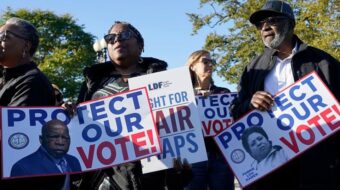
Then another wave came with the Civil Rights Movement, which forced democracy to mean something again—with the Voting Rights Act, the Fair Housing Act, and more. Millions of Black Americans, joined by labor, by the left, by people of conscience, bent the arc of history against Dixiecrat reaction.
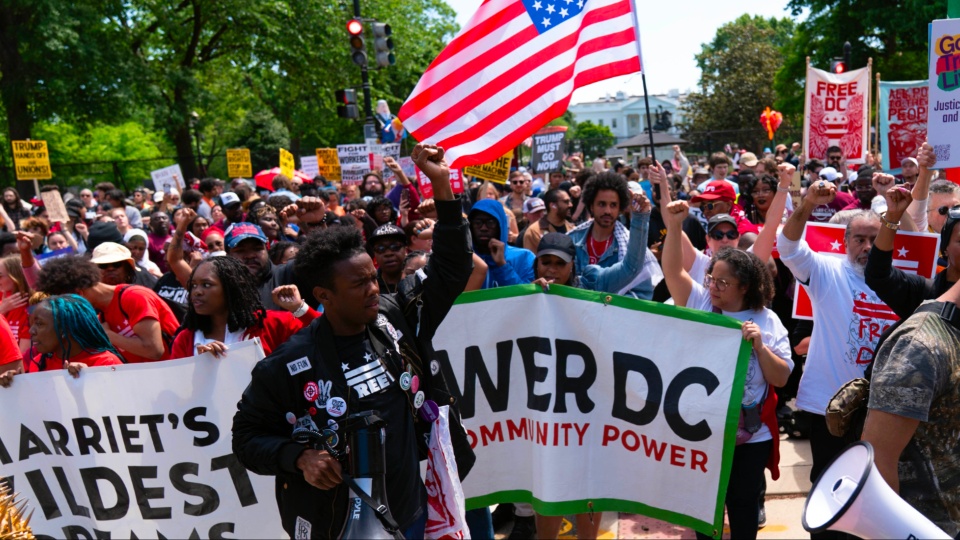
This all shows the lesson that no amount of “Freedom 250” MAGA rallies or White House cage matches can obscure: Every advance of genuine democracy in American history has come from below, over the objections of those at the top. And every advance has been partial, contested, and vulnerable to rollback.
We are living in one of those rollback moments now. The Trump administration, the billionaire-funded demolition of regulatory government, the Musk-and-Thiel faction of the ruling class—none of these are aberrations in the story of American capitalism. They represent the system trying to shed the democratic pretenses it no longer finds useful.
They want an image of the revolution frozen at 1776—a founding mythology stripped of its radical content, useful for legitimizing power rather than challenging it.

But the American working class has its own history worth celebrating on this 250th anniversary: The great railroad strikes of 1877, when workers fought back with a fury that instilled fear in the ruling class. The triumph at Flint in 1936-37, when autoworkers sat down and would not move until they had a union. The March on Washington. The Memphis sanitation strike. The mass movement to end the war on Vietnam. Dolores Huerta and the farmworkers. Stonewall 1969. Standing Rock. The teachers’ rebellions of 2018 and 2019. The women’s marches against Trumpism. The UAW’s Stand-Up Strike. The Minneapolis General Strike against ICE.
All of these are episodes in the long, imperfect, incomplete march of the American people toward what the Declaration of Independence actually promised. It is a journey that points, however haltingly, toward socialism—toward a society where the people who do the work make the decisions, where the wealth produced by labor does not vanish upward into the pockets of those who own but do not work.

The revolution of 1776 is unfinished. The work of perfecting democracy—and ultimately transcending the class society that keeps sabotaging it—must still be completed.
On this July 4th, while the administration lights fireworks over a republic it is actively dismantling, let’s remember that the real American tradition isn’t the one being staged for the cameras. It’s the one being carried forward by everyone fighting, right now, to make the words of the Declaration of Independence fully mean something for all of us.
That’s the birthday worth celebrating.
The revolutionary tradition that birthed the Declaration of Independence also produced a free press as a democratic necessity—from the radical pamphlets of Thomas Paine to the abolitionist papers of Frederick Douglass to the labor press of the 20th century. People’s World, as heir to that tradition, carries the fight forward today against a ruling class that would rather the working class have no press of its own. The free press is the guarantor of moving toward a more perfect democracy, not the “enemy of the people” as the White House says. Please donate to help expand the reach of People’s World.
CONTRIBUTOR