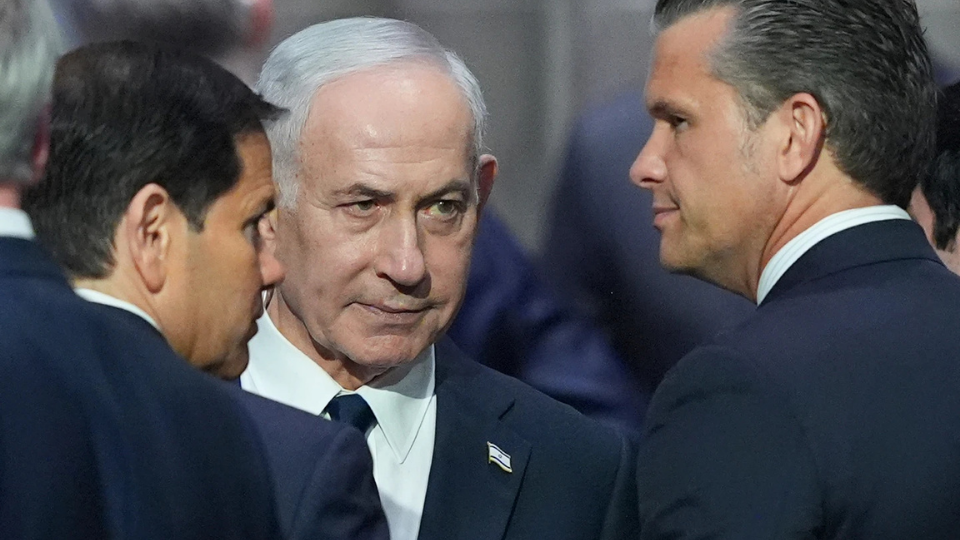
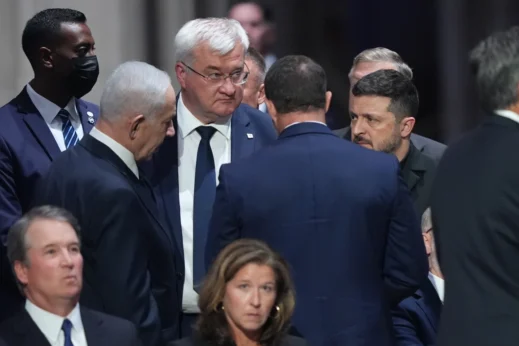
Ukrainian President Volodymyr Zelensky and Israeli Prime Minister Benjamin Netanyahu came to Washington, separately, for meetings with President Trump, following a Ukrainian drone strike on an Iranian cargo vessel in the Caspian Sea and a new intensification of the U.S.-Israeli war on Iran.
Both leaders attended the memorial service for Senator Lindsey Graham, a key Trump ally. Zelensky and Trump discussed expanded air-defense capabilities, including domestic production licenses for Patriot interceptors, which the president reportedly agreed to grant. Netanyahu’s talks focused on military aggression against Iran and Lebanon, as well as the expansion of the Trump-Netanyahu-backed Abraham Accords.
The back-to-back White House meetings underscored the interconnections of the Ukraine and Middle East imperialist wars and U.S. imperialism’s involvement—a convergence dramatically illustrated by the July 25 drone attack, which marked the first known Ukrainian strike in the Caspian Sea.
Ukrainian President Volodymyr Zelensky confirmed the operation, describing it as having achieved “very good results” and stating it targeted ships involved in transporting military cargo from Iran to Russia. Iranian authorities identified the vessel as the “Anna,” a dry cargo ship, and maintained it was engaged in civilian commerce, carrying steel from Russia’s port of Astrakhan to Iran’s Anzali Port.
The Caspian, an inland sea bordered by Russia, Iran, Azerbaijan, Kazakhstan and Turkmenistan, has grown in strategic importance since the onset of sanctions and war, and serves as a key logistics corridor between Moscow and Tehran.
Iran warns of retaliation
Iranian Foreign Minister Abbas Araghchi condemned the attack as a violation of the UN Charter and accused Zelensky of carrying it out at Israel’s urging.
Iran summoned Ukraine’s senior diplomat in Tehran, filing a formal protest. Iranian officials described the strike as “a hostile act threatening the security of all Caspian littoral states” and warned that Iran would not leave attacks on its citizens and property without a proper response.
The strike occurred amid a broader Ukrainian-NATO campaign against Russian energy infrastructure. Reports indicated Russian refineries had been hit at least 194 times since January, reducing refining capacity by roughly one-third and creating fuel shortages inside Russia.
At the same time, Iran has again closed the Strait of Hormuz, and Houthi forces in Yemen have threatened the Bab el-Mandeb strait, disrupting two of the world’s most important shipping lanes. Analysts estimate that approximately 20 to 25 percent of global oil capacity is affected, forcing tankers onto longer routes and driving up shipping costs, insurance costs, and energy prices, especially in developing countries.
Tensions surged on Tuesday as Iran launched an attack on a U.S. military base in Jordan. Simultaneously, joint U.S.-Saudi forces targeted alleged Iran-backed forces in Iraq, and Houthi forces in Yemen claimed responsibility for a missile strike on a Saudi oil tanker.
The combined effects of the war are already reaching consumers worldwide, however, with higher fuel costs leading to increased prices in freight, food, and manufacturing.
Left-wing groups warn of escalation dangers
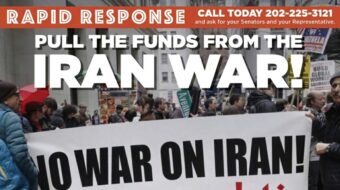
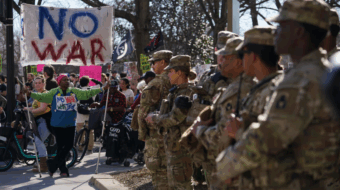
Anti-war organizations and left-wing political parties in the United States have cited the Caspian strike as evidence that the conflicts in Ukraine and the Middle East are dangerously merging. The Communist Party USA continues to demand an end to both imperialist wars, congressional oversight of U.S. military action, and urged the working class to organize immediate, broad, loud, and peaceful resistance.
“The U.S. working class does not benefit from the forever wars being waged in our name by the U.S. government of billionaires,” the CPUSA asserted.
The party argued that working-class families are already bearing the costs through higher fuel and food prices and that resources should be redirected from the war economy to domestic, peaceful needs. Other peace organizations have echoed these concerns, warning that the convergence of the two wars increases the risk of a broader generalized war.
Reports indicated the Trump administration is considering an expanded range of military operations in the war on Iran, including possible ground operations and strikes on nuclear-related sites. As Iran vows retaliation and Ukraine signals readiness for additional strikes on both Russia and Iran, tensions across the world show no sign of easing.
This article includes reporting from People’s World, Rizospastis, PressTV, and Morning Star
We hope you appreciated this article. At People’s World, we believe news and information should be free and accessible to all, but we need your help. Our journalism is free of corporate influence and paywalls because we are totally reader-supported. Only you, our readers and supporters, make this possible. If you enjoy reading People’s World and the stories we bring you, please support our work by donating or becoming a monthly sustainer today. Thank you!
CONTRIBUTOR