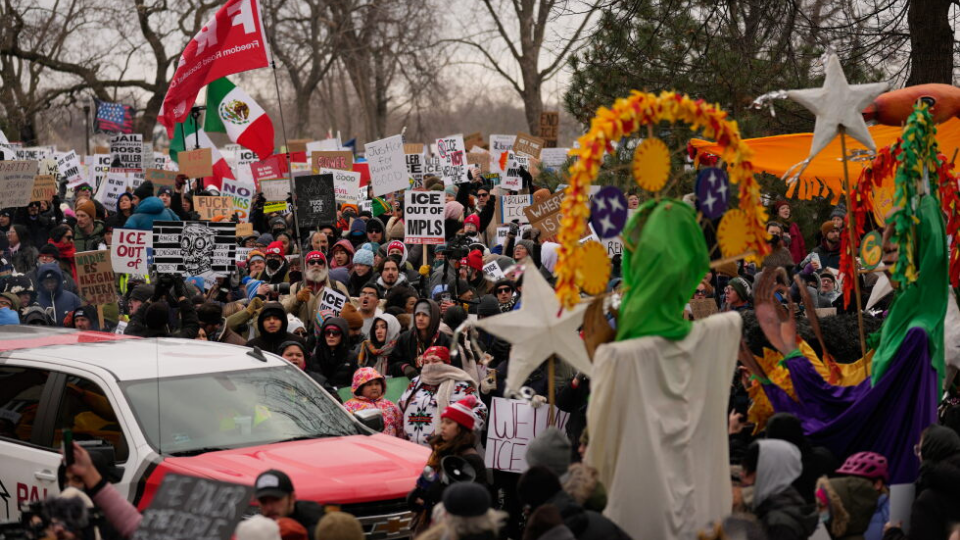
MINNEAPOLIS —Taking their cue from the successful mass anti-ICE protests in the Twin Cities early this year, thousands of activists converged on Minneapolis-St. Paul in late August to unite on defending democracy—and to strategize on how to do it.
“We must take the lessons we have learned from the resistance in Minnesota, and around the country, and apply them to the upcoming threats on civil society, likely the 2026 elections,” the activists, convened as the National Convergence for Democracy, declared.
Peaceful opposition to Trump and his Operation Metro Surge—the massive ICE roundups— “demonstrated how nonviolent resistance to authoritarianism works,” they added. Their goal:
“Encourage solidarity across race, gender, and region, aiming to strengthen collective capacity to defend democracy and respond to crises effectively.”
Convergence participants worked on crafting “a coordinated effort to prepare organizers and communities for democratic defense, combining education, practical skills, and strategic planning to address contemporary threats to civil society in the United States.”
While planning anti-authoritarian actions nationally, the activists decided to concentrate their efforts on swing states where voters could decide the makeup of the next Congress: Georgia, Iowa, Kansas, Michigan, Minnesota, North Carolina, Ohio, Texas and Wisconsin.
All those states except Wisconsin have key U.S. Senate races. The Republicans, backed by MAGA legions and corporate millions, hold a 53-45 margin in the Senate, with two independents who caucus with the Democrats. All the key states, including Kansas and Wisconsin, have key U.S. House races. The GOP holds the House 218-212 with two independents and four vacancies.
And the activists will also concentrate their anti-voter-suppression efforts on big cities with large shares of voters of color. Among them are Chicago, Los Angeles, D.C., Boston, the Twin Cities, New York, Raleigh-Durham, N.C., and the San Francisco Bay Area.
“Now, as state violence and attacks on Black representation and all of our votes escalate, we’re expanding our Solidarity Schools and planning training across the country to be able to act fast and in coordination whenever our communities are threatened,” the convergence sponsors add.
“What working people pay more for, those at the top profit from…None of this is an accident: It is the result of a system that prioritized private profit over public well-being,” a previously published agenda by one key participant, May Day Strong, declares.
Conferees met at a time when the tyrannical GOP Donald Trump regime is increasing its threats to future democracy in the U.S., as shown by both public polling and the latest decision, on August 24—the day after the conference ended—by the U.S. Supreme Court.
There, the court, acting on an “emergency docket” demand from Trump, let him proceed with his crusade against voting by mail. They overturned a lower-court ruling upholding that choice made by tens of millions of voters,
The 6-3 vote was on partisan lines: All GOP-named justices for, Democratic-named justices against.
And the polls, by the Pew Research Center, show trust in whether democracy works for everyone, not just the rich, has hit an all-time low, both compared to past U.S. surveys and to the rest of the group of “rich” nations in the G7. Now, 70% of respondents reply that the U.S. “used to be a good democracy, but now it isn’t.” Another 7% say “it never was.”
Anticipating the High Court’s ruling, the activists, including union members, progressives, religious leaders and civil rights and civic leaders, urge citizens to double-check that they’re still registered, and then to cast their ballots early—before Election Day, November 3—but not mail them in.
The key point of all the strategizing, organizing, mobilization and even, if needed, strikes is to create and activate such a massive movement, uniting such a wide range of people with a wide range of interests, that their votes overwhelm the radical right Trump supporters.
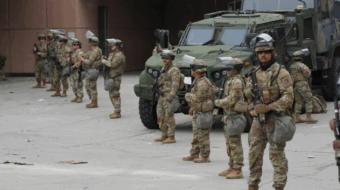
Early voting, participants believed, is a top way to battle Trump, his MAGA forces and even his troops in the streets, whom he could use to intimidate or—as his ICE agents are now doing at airports—arrest people while they’re standing in line to vote.
ICE is now invading airports and arresting people, including citizens on trumped-up charges of visa fraud filled out on blank “administrative warrants,” rather than real judge-issued warrants.
Many workshops at the three-day National Convergence “were dealing with making sure everybody had the right to vote” this fall, said Mark Froemke, a labor activist from Northwest Minnesota.
Other sessions dealt with energizing African-American, Latinos/Latinas, Asian-Americans and other people of color, despite threats and intimidation. But the participants also looked beyond November 3, Froemke added.
“They’ll try to reverse the results” if this year’s vote goes against them, he said of Trump and his legions, and then put together structures to suppress the vote in 2027-28.
Delegates discussed and participated in workshops on “anti-authoritarian political education” using Minnesota’s mass response as an example, along with other examples of resistance from both the U.S. and abroad.
In scenes viewed around the world, more than 100,000 people hit the streets of the Twin Cities in late January after Trump agents during the Trump-ordered Operation Metro Surge shot dead two peaceful civilian observers, union member Alex F. Pretti, RN, a Veterans Affairs Department hospital nurse, and Renee Nicole Good, a local activist.
Participants also discussed non-cooperation with repressive authorities, coordinated rapid response —a tactic the Steelworkers pioneered—and decentralized mobilization, thus making it harder for any Trump MAGAites, troops, and occupiers to find, arrest, and detain them.
The decentralized mobilization may be particularly vital in the wake of recent disclosures that ICE agents infiltrated and spied on peaceful meetings of unionists, activists, progressives and anyone else planning anti-ICE actions in the days before and after Operation Metro Surge.
Other conference sessions focused on legal advocacy, organizing by faith leaders, and “collective action, strikes, and coordinated campaigns to resist authoritarianism.”
The faith leaders had their own “stream,” one of four within the main conference. Organized by Jewish and mainline Protestant leaders, they discussed “bearing witness” to authoritarian actions, including at ICE detention centers, and other ways to “make sure elections are free and fair with no voter suppression.”
They planned how to “challenge injustice and preserve human dignity” in the face of authoritarianism.
They also planned for mutual aid to people whom the authoritarians particularly threaten, such as people of color, migrants, and workers.
Bearing witness was what Worker’s Circle, the progressive Jewish labor group, and mainline Protestant clergy and parishioners have done for months at one infamous ICE camp, “Alligator Alcatraz,” at an abandoned regional airport west of Miami.
And the faith leaders, like other activists, may be willing to be arrested to dramatize the authoritarianism they and voters face. Approximately 400 flew into Minneapolis-St. Paul for the mass anti-ICE protests in January, Froemke said, and more than 100 were arrested at one protest at the Minneapolis-St. Paul International Airport, news reports added.
We hope you appreciated this article. At People’s World, we believe news and information should be free and accessible to all, but we need your help. Our journalism is free of corporate influence and paywalls because we are totally reader-supported. Only you, our readers and supporters, make this possible. If you enjoy reading People’s World and the stories we bring you, please support our work by donating or becoming a monthly sustainer today. Thank you!
CONTRIBUTOR