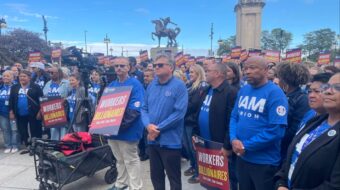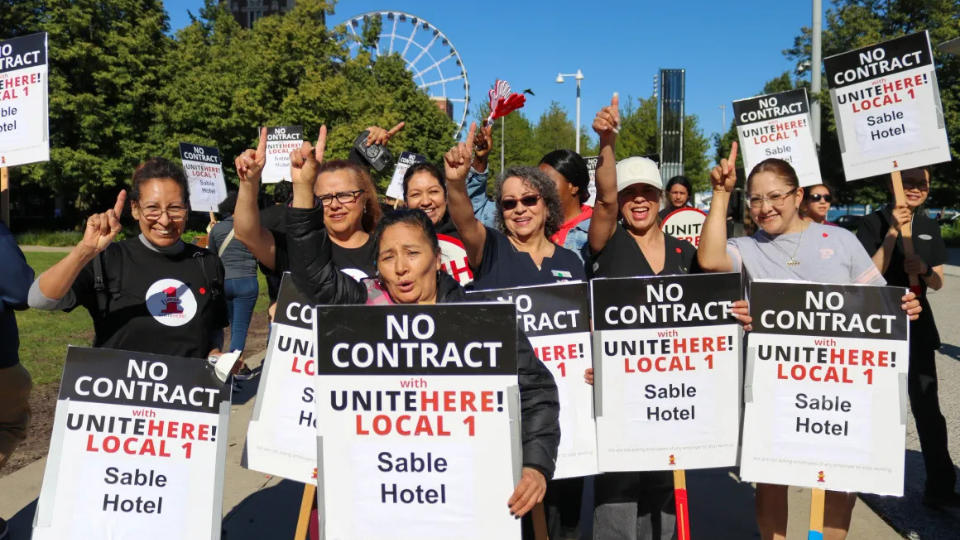
CHICAGO —By an 85%-15% margin the voting members among 7,000 workers in Chicago’s leading hotels voted on September 22 to authorize a strike.
The 46 hotels where the strike, if there is one, could occur are predominantly in the Loop, the West Loop, the Magnificent Mile on North Michigan Avenue and all the hotels around the giant McCormick Place convention complex on the near South Side.
The sole outlier is a hotel at the University of Illinois-Chicago. The Hyatt, Marriott and Hilton chains own most of the hotels. The Pritzker family, including Democratic Gov. J.B. Pritzker owns the Hyatt chain, though the union, Unite HERE Local 1, did not mention that.
Bargaining began in June and most contracts simultaneously expired on September 1 for maximum impact at the height of Chicago’s convention and tourist season. Other unions representing hospitality workers also use that strategy, sometimes at convention hotels across North America.
Of the 46 Chicago hotels, two have no contracts and pacts at two, including the historic Blackstone Hotel on South Michigan Avenue, expire December 15. One pact each expired on Jan. 31, 2025, April 30, 2025, Sept. 29, 2025, April 30, 2026 and May 5, 2026. Workers at the Holiday Inn Express at 540 North Wabash Avenue, have been toiling under a contract that expired on New Year’s Eve 2019.
The union put out a travel alert for Chicago visitors, posted on its website, saying actions would be “up to or including a strike or boycott.” The warning added: “Events you are hosting in Chicago may be impacted. Some events being held at these hotels have already chosen to cancel or reschedule their events.”
“Tourism in Chicago is booming, all while inflation is increasing, and it’s affecting our hotel workers across the industry,” Local 1 President Karen Kent, said in an union statement.
“They feel the weight anytime they go to the supermarket to buy food, or when they come home from work and are too tired to spend time with their family. Workers are ready to strike because they work too hard to live like this,” Kent continued.
Low pay and erratic work routes within hotels are key issues. Local 1 said a third of its members surveyed , two-thirds had their hours cut during slow periods and 25% were forced to turn to payday lenders—who charge exorbitant interest—to cover expenses. The Chicago hotel workers include attendants, cooks, dishwashers, front desk agents, servers and food service workers.
“I voted yes to strike because I’ve had enough,” Palmer House room attendant Cassandra Pope told Local 1. “They demand and demand, always rushing us in the rooms, without acknowledging that we are human beings.” Added Westin River North room attendant Davila Garcia: “These companies make all the profit and don’t give us back our share.”
The local adds the three chains can afford to raise the workers’ pay, since they returned $22.3 billion to shareholders over the last three years. Meanwhile, the union website has a wide array of aid available to striking workers, from help seeking jobless benefits to locations of food banks to video on what to do to manage your expenses during a strike.
No paywalls at People’s World
We hope you appreciated this article. At People’s World, we believe news and information should be free and accessible to all, but we need your help. Our journalism is free of corporate influence and paywalls because we are totally reader-supported. Only you, our readers and supporters, make this possible. If you enjoy reading People’s World and the stories we bring you, please support our work by donating or becoming a monthly sustainer today. Thank you!
CONTRIBUTOR