PARIS—With millions of students in the streets demanding a future for working-class youth, Fabien Roussel is proposing a pact to change the direction of French education.
The national secretary of the Communist Party (PCF), whom party members have chosen as their candidate in next spring’s presidential election, presented his plan for young people on Tuesday, Oct. 6.
Roussel spoke at a press conference at PCF headquarters, joined by Camille Mangin and Bastien Bonnargent, the leaders of the Union of Communist Students and the Young Communists, respectively.
“The government is choosing repression to silence the protests,” Roussel charged. “We have a duty to understand” the anger driving the high school movement, “you as journalists, we as political leaders,” he said, shortly before leaving to join the students in the streets of the capital.
A revolt that started in one suburban school
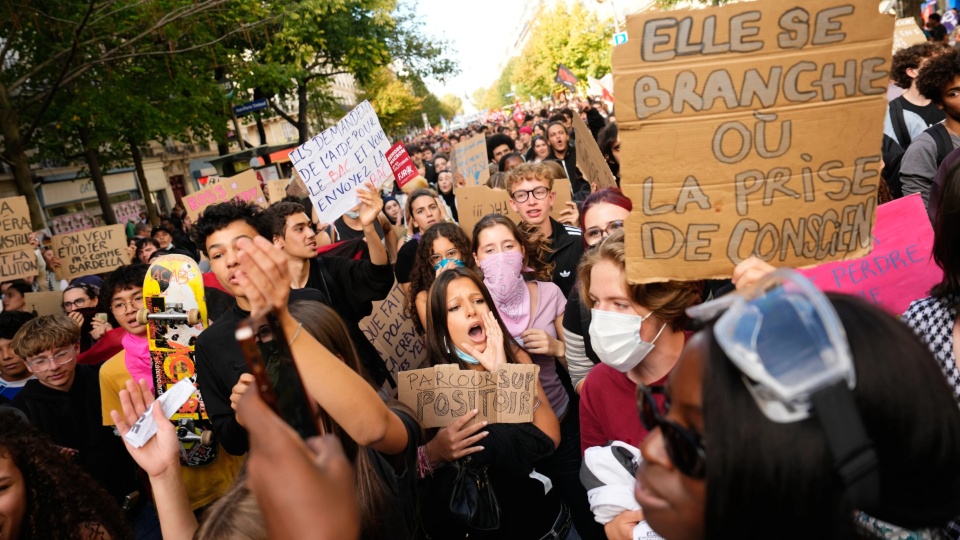
The demonstrations Roussel was heading to are part of a nationwide student revolt that has rattled the French government. The movement began in mid-September at Lycée Saint-Exupéry in Créteil, a working-class suburb southeast of Paris, where students walked out in solidarity with teachers demanding more staff.
Within days, “blockades”—students barricading their school entrances, a long-standing tactic of French youth protest—had spread across the Paris region and then the whole country. By Sept. 30, about 1,200 high schools, roughly half of France’s public lycées, had seen some kind of disruption, and more than 400 were closed outright on Oct. 2.

The students’ complaints are concrete. Chronic teacher shortages leave classes uncovered for weeks at a time: nearly 10% of teaching hours in public secondary schools went untaught in the 2024-25 school year. Classrooms are overcrowded, and many buildings are falling apart, with leaking roofs, broken toilets, and no cooling during increasingly brutal summer heat waves.
Students also object to Parcoursup, the national online system that sorts high school graduates into college programs, which many find stressful and opaque. Their organizations are demanding more teachers, smaller classes, emergency money for school repairs, and a major overhaul of Parcoursup.
Those demands collide head-on with austerity. The government of Prime Minister Sébastien Lecornu, under pressure from President Emmanuel Macron to shrink France’s deficit, presented a 2027 budget on Oct. 1 that eliminates 1,588 teaching positions, citing falling enrollment.
On the streets, the state’s answer has been the police. Officers have fired tear gas and stun grenades at crowds of teenagers, and more than 6,000 people have been arrested since Sept. 28, most of them minors.
A 15-year-old in the northern city of Lens lost his hand to a grenade, and a 16-year-old in Tours lost the sight in one eye, according to Amnesty International, which has condemned the use of disproportionate force against young protesters.
Authorities, for their part, report hundreds of police officers injured and more than 100 schools badly damaged, some set on fire, and the police internal affairs office has opened 10 investigations into officers’ conduct.
On Oct. 5, Lecornu announced five “work streams” covering teacher replacement, building conditions, school life, Parcoursup, and student participation, promising first decisions by the end of October, while insisting that any new spending respect “public budget constraints.”
Student groups say they want concrete measures, not more consultation. Tuesday’s marches, the movement’s third national day of action, drew university students as well, along with backing from the CGT labor federation.
Youth worried about the future
Roussel cited polling showing that 66% of 15- to 17-year-olds are worried about the future, and that 70% of young people find the world of work more stressful than fulfilling. He called on the government to open a dialogue “with youth organizations,” which he wants to see strengthened, instead of “stigmatizing” the current movement.
At the heart of Roussel’s Youth Plan 2027-2032 is money. In the immediate term, he is calling for a supplementary budget bill to put €5 billion ($5.6 billion) toward renovating high schools. Beyond that, he wants a “planned” approach that would commit €5 billion ($5.6 billion) a year for five years to modernizing school buildings.
“Sixty percent of schools were built before the 1980s,” Roussel noted, and some are no longer fit to house students as the climate changes.
He also wants another €3.5 billion ($3.9 billion) to hire the 90,000 teachers needed to reduce class sizes and to guarantee that any absent teacher is replaced within 24 hours. Right now, 15 million teaching hours go unfilled.
To pay for it, Roussel would redirect part of the €211 billion ($236 billion) in public aid that businesses receive with no strings attached, a figure documented by a Senate inquiry last year, and shift some money from the defense budget.
Noting that some of these demands enjoy broad support, Roussel is calling for an “emergency pact” among all political parties. Without waiting for the presidential election, it would write into the 2027 budget “the spending needed for the commitments we agree on, around simple objectives,” such as renovating buildings, capping class sizes, and replacing absent teachers.
“This pact will form the backbone of our government’s education policy over the next five years,” the candidate said. “It will give direction to a general mobilization of all the nation’s civic forces.”
Other proposals include reorganizing the school week around 32 hours of class, scheduled between 9 a.m. and 5 p.m., and strengthening student democracy.
The goal, Roussel said, is to “give every young person, whatever their background, the means to educate themselves, to train, to be free, and to understand the world, free to choose their own path, in order to build a France where women and men can live freely, liberated from the dictatorship of the markets and the law of profit.”
An earlier version of this article appeared in French in L’Humanité. It has been expanded with additional contextual material for our U.S. audience.
No paywalls at People’s World
We hope you appreciated this article. At People’s World, we believe news and information should be free and accessible to all, but we need your help. Our journalism is free of corporate influence and paywalls because we are totally reader-supported. Only you, our readers and supporters, make this possible. If you enjoy reading People’s World and the stories we bring you, please support our work by donating or becoming a monthly sustainer today. Thank you!
CONTRIBUTOR