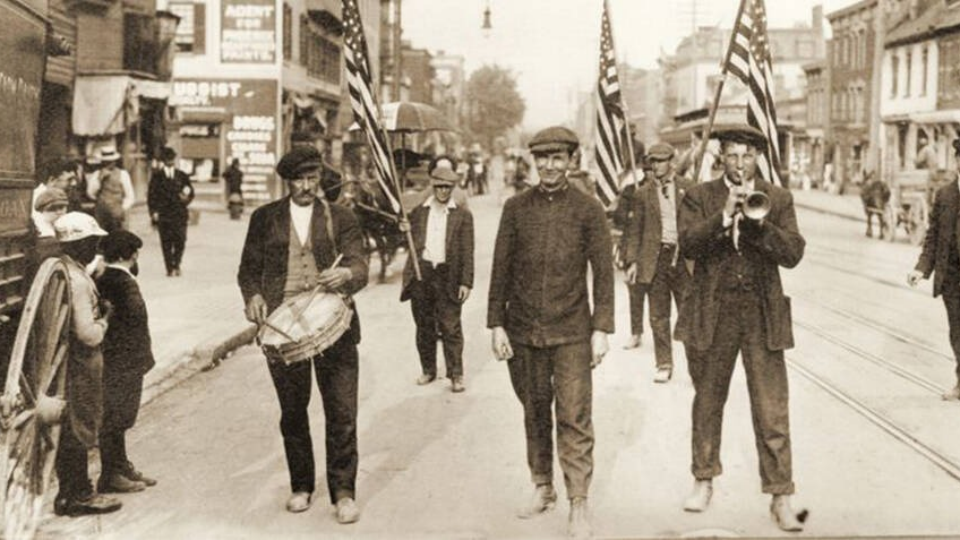
On March 16, 1894, hundreds of unemployed men walked out of Los Angeles behind Lewis Fry, a former soldier and organizer for the American Federation of Labor. Nine days later, on Easter Sunday, Jacob Coxey led a few hundred more out of Massillon, Ohio. On April 3, 600 San Francisco men marched down Market Street to the Oakland ferry under a banner that read “We Are Hungry and Discouraged.”
Some of these armies organized on their own, and the press and the public soon welded them to Coxey’s name. By summer, newspapers counted 23 armies and major contingents, rolling toward the capital from the Pacific coast, the Rockies, the Plains, and the Great Lakes at once. Nothing like it had happened in the United States. It was the first March on Washington.
The country they marched through had no unemployment insurance and no relief beyond charity and the stone pile. The Panic of 1893 had closed banks, railroads, and mines, and as many as one in four workers were out of a job. Coxey’s program was plain: federal road-building, paid for with non-interest-bearing bonds, to put the idle to work. Editors called it radical madness. The marchers called their march a petition in boots.
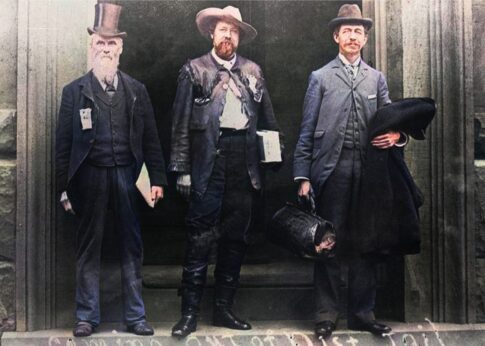
The railroads answered the way railroads did. In west Texas, a Southern Pacific crew uncoupled the cars holding 500 marchers and left them stranded in the desert for nearly a week, as Smithsonian magazine has recounted. In Montana, Butte miners under William Hogan seized a Northern Pacific train, and townspeople helped them switch engines and refuel at the junctions while federal deputies chased them across the state.
The men took trains because trains were the only road to Washington that a man without a dime could afford. Fry’s Los Angeles men seized a Southern Pacific train at Ontario, California, and the next town on their route fed them. “The citizens of Colton, regardless of politics, vied with each other in contributing to the comfort of the Industrial Army,” the Los Angeles Herald reported.
Portland showed what the powerful feared most. Scheffler’s army took a train and ran it up the Columbia, and U.S. marshals chased them 120 miles before the cavalry caught them. Historian Steven Piott records what the marshals found when they searched 507 prisoners: three revolvers, a few butcher knives, and some shaving razors. The soldiers were ordered to give the men water but no food.
Then the city turned out. About 1,000 people cheered as the 52 accused leaders were marched to jail. When the judge, under pressure from a sympathetic crowd, let them go on April 30, 3,000 of Portland’s workers paraded in their honor. The next day, May 1, more than 3,000 men and 100 women marched in the city’s International Labor Day parade. No riot was reported.
The armies were not pure. Fry’s three-point program demanded federal jobs for the jobless, but it also demanded a 10-year ban on immigration, a reminder that the fight over who counted as “the people” was already underway. Alcohol was banned in many camps, and Black and white marchers often lived side by side. Respectable women joined the western armies. After the Montana chase, more than 50 copycat gangs went on to steal locomotives around the country.
Coxey reached Washington on May 1 with about 500 men. He was arrested for walking on the Capitol grass. The other armies were jailed, turned back, or dissolved on the road. A young Californian named Jack London, 18 and out of work, joined Kelley’s Industrial Army, and he later wrote about the road in The Road. The march never got its bill.
But what the marchers demanded came, piece by piece, over the next 40 years. Public works. A minimum wage. A government that answered to working people. In 1905, the Industrial Workers of the World set out to organize the same drifting, jobless workers the craft unions of the day had turned away, under the banner of one big union of all the workers. In 1933, fewer than three million Americans carried a union card. Then came the Wagner Act, the CIO, and the 44-day sit-down strike at General Motors in Flint, Mich. By 1944, nearly 15 million did.
That line from 500 men with a petition to 15 million holding union cards is not straight. It runs through blacklists and bullets and broken strikes. But it is a line, and the men who walked out of Los Angeles on March 16 were standing on it before they knew it.
No paywalls at People’s World
We hope you appreciated this article. At People’s World, we believe news and information should be free and accessible to all, but we need your help. Our journalism is free of corporate influence and paywalls because we are totally reader-supported. Only you, our readers and supporters, make this possible. If you enjoy reading People’s World and the stories we bring you, please support our work by donating or becoming a monthly sustainer today. Thank you!
CONTRIBUTOR