The future of United Nations mediation in Western Sahara’s struggle for self-determination is in unprecedented jeopardy as the Trump administration looks to strip the funding and legal mandate from UN representatives in the region.
Under a set of U.S.-led proposals circulated early this month among members of the UN Security Council, the UN Mission for the Referendum in Western Sahara (MINURSO) would immediately lose half of its staffing. Its name would immediately change to “MINUSO,” taking out any reference to the referendum on self-determination that was guaranteed to the Sahrawi people by a UN resolution in 1991. Under the Trump administration’s plan, MINURSO’s limited mandate would lapse in April 2027, and UN observers would vacate the region entirely by November of that year.
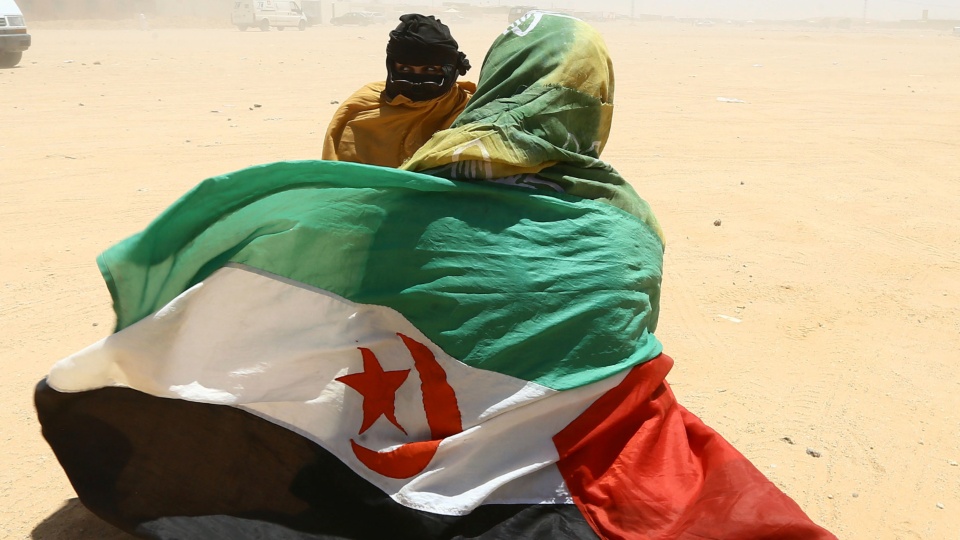
Sahrawi refugees, who have lived in a sprawling set of camps in Tindouf, Algeria, for generations, would also be forced to register with the UN High Commissioner for Refugees (UNHCR)—a move which U.S. and Moroccan delegations see as a means of imposing tantamount statelessness on the Sahrawi people, denying the sovereignty of the Sahrawi Arab Democratic Republic (SADR) and the Polisario Front as its government.
Morocco’s envoy to the UN has appealed cynically to the humanitarian situation in Tindouf, neglecting to reference Morocco’s campaign of ethnic cleansing and settler-colonialism, which expelled a majority of the Sahrawi population from Western Sahara in the 1970s.
The U.S. proposal cites 2025’s UN Resolution 2797, which renewed MINURSO’s mandate for an additional year but included language that suggested a shift toward support for Moroccan annexation. The U.S. resolution also refers to a May 2026 attack on the Moroccan-occupied city of Smara as a pretext for ending negotiations outright.
The maneuvers playing out within the Security Council contravene the will of the UN’s General Assembly, in which over 150 countries reaffirmed their commitment to the UN-mediated peace process, decolonization and Sahrawi self-determination in a resolution earlier this month. Only the United States and Israel voted against the resolution; seven delegations abstained.
The struggle over Western Sahara’s future is a key theater of imperialist aggression taking shape in the United Nations this year.
Cuba has likewise faced a campaign of intimidation in the lead-up to this year’s UN vote against the illegal U.S. blockade, as the Trump administration attempts to destroy the island’s energy infrastructure and threatens a military invasion to overthrow its sovereign government. Secretary of State Marco Rubio and other key Trump-administration figures have threatened opponents of the criminal blockade with tariffs and other economic escalations if they vote to condemn it in the General Assembly.
Cuba and the SADR have a long history of confronting imperialist aggression together, in UN deliberations and in self-defense on the ground. The two governments are historic allies and have consistently demanded respect for their own sovereignty, as well as that of the Palestinian people, in their international presence.
Polisario and peace forces respond
The Polisario Front has indicated that it will withdraw from the peace process entirely if the Trump administration’s efforts succeed. Though MINURSO originally emerged as a component of ceasefire negotiations between Polisario and Morocco in the early 1990s, the Moroccan government has stalled its efforts to organize a referendum for decades and systematically violated its mandates to free Sahrawi political prisoners and oversee the demilitarization of the region.
In an Oct. 22 statement addressed to the president of the UN Security Council, the Polisario representative to the UN emphasized that the U.S. proposal “is another extremely dangerous, unprecedented departure not only from the principles of international law underpinning Western Sahara as a question of decolonization, but also from the basis upon which the Security Council has addressed Western Sahara.
“Any attempt to legitimize aggression and acquisition of territory by force cannot serve as a basis for a consensual, just, and sustainable solution. On the contrary, it will inevitably compromise regional peace and security and trigger further tension and instability.”
As the Moroccan government turns to the Trump and Netanyahu regimes to pursue its international objectives, domestic forces for peace and democracy have rallied their supporters in massive street protests. In response to the expansion of Israeli influence in Rabat, including a new embassy and military-economic cooperation agreements, demonstrations have erupted across the country demanding an end to support for the genocide in Gaza.
The Palestine solidarity protests correspond to September’s elections, in which Morocco’s limited democracy—which is subordinate to its powerful monarchy—saw its legitimacy collapse, especially among young people. Members of left-wing student groups which protested in days leading up to the election were attacked and arrested by police. Further, the government has taken no public responsibility for its role in July’s Ceuta disaster, in which it leveraged tens of thousands of underemployed young people as a political weapon against Spain.
For its part, the Trump administration has kept a close eye on the region’s phosphate reserves, with skyrocketing fuel and fertilizer prices threatening MAGA’s electoral prospects in key states like Iowa, Kansas, and Nebraska. While the administration’s imperialist wars and trade conflicts have greatly exacerbated the spiraling cost-of-living crisis in the United States, it has created a growing range of carveouts for Morocco, incorporating the country into its diplomatic pole along with Israel and extreme-right and fascist governments in Latin America.
Down to the wire
As with Cuba, international allies have spoken up for Polisario and the Sahrawi people, rejecting the Trump administration’s intimidation campaign. However, the current Security Council skews disproportionately toward supporters of Morocco’s annexation plan, and the Moroccan diplomatic apparatus has worked to sway potential vetoes, especially Russia.
China, which has maintained formal neutrality in the conflict while promoting economic ties with Morocco and refusing to recognize the SADR’s sovereignty, is one of the few Security Council members to not yet signal a position on the upcoming vote, and it is one of the few remaining possible vetoes. Along with Pakistan as a rotating member without veto power, China and Russia abstained from last year’s vote on Resolution 2797. The remaining delegations voted to approve it.
The UN Security Council will vote on the U.S. resolution on Oct. 30. The vote to condemn the illegal blockade of Cuba is set to take place just days beforehand, on Oct. 27 or 28.
No paywalls at People’s World
We hope you appreciated this article. At People’s World, we believe news and information should be free and accessible to all, but we need your help. Our journalism is free of corporate influence and paywalls because we are totally reader-supported. Only you, our readers and supporters, make this possible. If you enjoy reading People’s World and the stories we bring you, please support our work by donating or becoming a monthly sustainer today. Thank you!
CONTRIBUTOR