MILWAUKEE, Wis.—They’re often overlooked by politicians and the press. Ads usually don’t play to them. But in an election with dozens of tight races in the upcoming midterms, some particular blocs of voters can swing the outcomes. That’s held true in the past, and it may hold true again.
Indigenous people who are voters in far northern Wisconsin. Farmers in Kansas, Iowa, and Nebraska. Libertarians in Texas. Union members in Mississippi’s unexpectedly close U.S. Senate race.
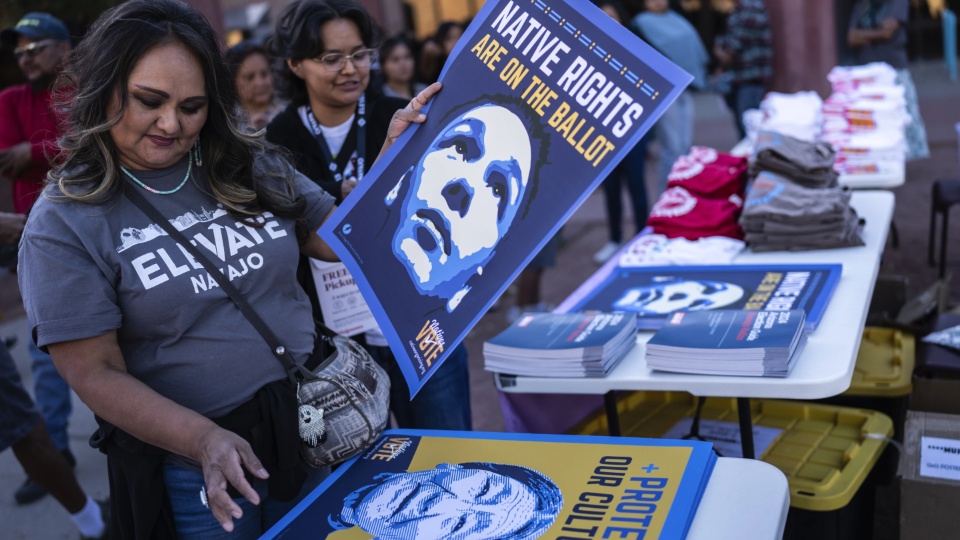
All those groups are small in numbers as part of the total electorate, such as 70,000 Native American voters in three counties of far northern Wisconsin, but they can’t be ignored. The Milwaukee Journal-Sentinel reports volunteers for groups encouraging Indigenous voter turnout, for instance, have sent thousands of handwritten postcards to voters in those northern counties.
Indigenous people voted heavily for Democratic presidential nominee Joe Biden in 2020, when he carried Wisconsin over GOP President Donald Trump by 20,065 votes out of 3.297 million cast.
The same thing happened that year in the presidential race in Arizona, like Wisconsin now a purple state. There are 310,000 indigenous registered Navajo voters there, along with large groups of Hopi and Tohono O’odham people.
News reports said Indigenous voters went heavily for Biden there, too. He carried Arizona by 10,447 votes out of 3.39 million cast. That race that featured a statewide recount with menacing armed Trump supporters surrounding the counting headquarters during a statewide recount of all the ballots.
This year’s tight Wisconsin race is for the governorship, pitting Milwaukee County Executive David Crowley (D) against business owner and GOP Rep. Tom Tiffany, a down-the-line MAGA loyalist. Opinion polls in the weeks before the Nove. 3 election give Crowley a three-point lead, within the margin of error.
Then there are the farmers in the Midwest. The last time a substantial share of the U.S. farm vote in that region went Democratic was in Harry Truman’s upset of Republican nominee Thomas E. Dewey in 1948. Even in Lyndon Johnson’s 1964 landslide, the farmers—barely—went Republican.
But post-World War II GOP farm policies clobbered those 1948 farmers, just as Trump’s tariffs and his Iran War have clobbered this year’s farmers. The tariffs and the war combined to raise the costs of imports the farmers need, especially diesel oil for their machinery and fertilizer for their fields.
So analysts have told The Hill that the big GOP fear is not necessarily that the farmers will vote Democratic, but that disgust with Trump and dismay at the impact of his policies will prompt them to stay home instead. And if they do, that means fewer votes for GOP U.S. Senate nominees—and improved chances for progressives to win.
The Libertarians could be the difference in Texas, where Democratic State Rep. James Talarico, a former seminarian and strong supporter of unions, is neck and neck with scandal-scarred state Attorney General Ken Paxton.
With Trump’s support, Paxton, who was impeached by his own party in the Texas House, beat incumbent Sen. John Cornyn in the GOP primary and the wounds haven’t healed. But overlooked in all of this is that in Texas’s last U.S. Senate election, two years ago, Libertarian nominee Ted Brown got 267,039 votes (2.3%), even as GOP Sen. Ted Cruz won by 8.5%.
“The real fight in this country isn’t Left vs Right; it’s Top vs Bottom. Right now, the rich are getting richer, and the rest of us are struggling to get by,” Talarico told Ballotpedia in responding to its candidate survey.
And in a state with a high proportion of evangelical voters, Talarico often quotes the New Testament, reminding listeners of its commands to heed—and feed—the poor.
Opinion polls show Brown is pulling 2% again, while the Talarico-Paxton numbers range from a 49%-49% tie to a five percentage point Talarico lead. But most put his margin at 2%.
Then there’s Mississippi. First-term GOP Sen. Cindy Hyde-Smith unexpectedly is down to a 4% lead over 16th Circuit District Attorney Scott Colom, whose circuit covers four rural counties. The race is so close that Trump actually campaigned for Hyde-Smith last week in the Magnolia State.
The Mississippi AFL-CIO, the Electrical Workers (IBEW), and the campaign committee for the Congressional Black Caucus are among Colom’s backers. If he wins, Colom would be Mississippi’s first African-American senator since Reconstruction.
Which also means that if all of Mississippi’s 47,000 union members, and the other 34,000 whom unions represent—plus family members for both groups—turn out to vote, and vote Democratic, they too could help swing the race to Colom. Given the stark voting patterns common in the Deep South, they could make a difference.
No paywalls at People’s World
We hope you appreciated this article. At People’s World, we believe news and information should be free and accessible to all, but we need your help. Our journalism is free of corporate influence and paywalls because we are totally reader-supported. Only you, our readers and supporters, make this possible. If you enjoy reading People’s World and the stories we bring you, please support our work by donating or becoming a monthly sustainer today. Thank you!
CONTRIBUTOR