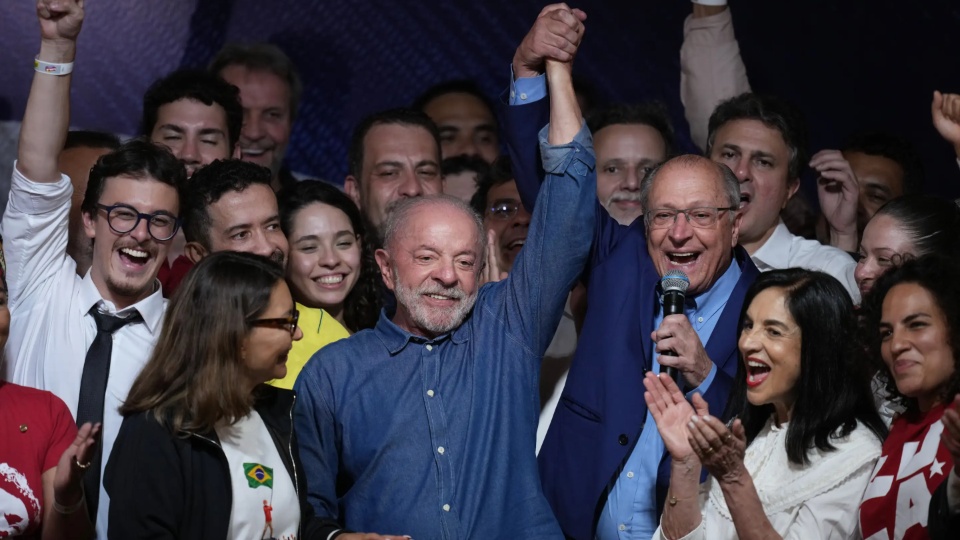
On Oct. 25, Brazil’s electoral court declared Luiz Inácio Lula da Silva re-elected with 51.79% to Flávio Bolsonaro’s 48.21%, a margin of about 4.4 million votes. Three weeks earlier, he had trailed by 2,224,965 votes, and no candidate since direct elections returned in 1989 had ever overturned a first-round defeat.
There are some important lessons to learn.
The first lesson is that empire can be refused. Last December, the United States National Security Strategy proclaimed a “Trump Corollary” to the Monroe Doctrine. In Venezuela, it meant force. In Argentina, Trump said of Javier Milei: “If he loses, we are not going to be generous,” with $20 billion on the table.
In Brazil, it meant a 50% tariff imposed to stop the coup trial of Jair Bolsonaro, Magnitsky sanctions on the judge who presided, terrorist designations for Brazil’s gangs two days after Flavio met Trump in the Oval Office, and a list of 21 trade demands that included the release of political “dissidents,” meaning the coup plotters of Jan. 8, 2023.
Right-wing candidates had won the region’s last seven general elections. Carlos Martinez and Sara Vivacqua wrote previously that if Lula held on “a country of 214 million people will have shown that tariffs, sanctions, terrorist designations, and foreign money can be faced down” and called it “a lesson the whole of the global South is paying attention to.” He held on.
Brazil is, as Imran Khalid put it in Foreign Policy in Focus, “China’s customer before America’s:” A large economy with diversified trade can absorb a tariff that would break a small one.
In 2025, China took 28.7% of Brazil’s exports and the United States 10.9%, so when Trump’s tariff hit, Brazilian producers rerouted their goods to Asia, and the country closed the year with record exports. A country can only say no to Washington if its economy lets it. Brazil’s did; Honduras’s on the other hand would not.
Rent-seekers
The second lesson is that the empire has a domestic twin, the rentier. A rentier lives off owning things rather than working, i.e. interest on debt, rent on property, dividends on shares. In Brazil, the rentiers are the banks, investment funds, and wealthy families who hold the government’s bonds and collect the interest.
Record-low unemployment, rising real wages, and inflation inside the target band did not stop Lula losing the first round. Pedro Paulo Zahluth Bastos of Unicamp explains why.
Brazil’s interest rate is 13.75%, “close to 8.5%” after inflation, “more than any other economy in the top forty.” Banks lend to households at 62% a year and on revolving credit cards at 445%. “A record 51% of adults are in default.”
Before interest, the government deficit is 0.6% of GDP; after interest it is almost 9.5%. The gap, about 1.2 trillion reais ($223 billion) a year, “flows to the owners of public debt: banks, funds, pension plans, and the families at the top of the distribution ladder.”
Fernando Rugitsky, writing in New Left Review’s Sidecar blog, draws the conclusion. Credit expansion without wage growth meant that “financial inclusion quickly became financial expropriation,” and “lower unemployment and rising incomes mean little, as additional funds go straight to lenders.” Michael Roberts, in Counterfire, states the structural fact plainly: “Lula and the Workers Party have never challenged the rule of capital.”
The Workers Party’s method has been to pay the poor out of the state budget, through cash benefits and a rising minimum wage, while leaving the banks and bondholders untouched. That works while soya, oil, and iron-ore prices are high and money is flowing in. When prices fall, the interest bill keeps growing, the benefits get squeezed, and the poor feel the loss first.
Shifting the arguments
The third lesson is how the comeback was actually won. Not by listing the government’s achievements.
In the final three weeks, Lula moved the contest, in Bastos’s words, “away from identity and the culture war issues, where Bolsonarismo is strongest, and onto the economy, where it is weakest.”
Bolsa Familia, the monthly cash payment to 19 million low-income families, conditional on their children attending school and being vaccinated, rose 15%. The Senate was forced to vote, 75 to 1, for a 40-hour week with no loss of pay, and Flávio Bolsonaro had to vote for it. Online betting platforms that drained 62 billion reais ($11.58 billion) from households in 2025 were banned.
The Treasury was authorized to buy defaulted consumer debt at a tenth of face value. Then the movement did the rest: More than a million on Paulista Avenue, the largest crowd since the Diretas Ja campaign against the dictatorship; a volunteer WhatsApp network of more than 8 million; abstention down from 21.08% to about 19.2%, and 10.4 million votes added between rounds against Flávio’s 3.7 million.
The pollster Quaest found Lula at 58% among the poorest and Flávio at 57% among the richest.
Rugitsky notes that Thomas Piketty singles out Brazil as one of the few democracies where the poor have not abandoned the left. The poor do not vote left by instinct. In Brazil, they do so because the Workers Party raised their wages, fed their children, and organized in their neighborhoods. Where a left party stops doing that, as across much of Europe and the U.S., the poor drift right or stay at home.
Racial divide
The fourth lesson is that the class line is an ethnicity or race line and a land line. Brazil received 4,864,373 enslaved Africans, 46.2% of all those landed in the Americas, according to the Transatlantic Slave Trade Database, and abolished slavery last, in 1888, with no land for the freed.
Today, the national statistics agency IBGE reports, white workers earn 67.7% more per hour than black (preto) and brown (pardo) workers.
Lula won all nine states of the nort-east, the poorest region, where the 2022 census found that 73% of people are black or brown (preto or pardo, the two census categories that Brazil’s statistics agency and its black movement count together as the black population) and the share who identify as black is the highest in the country.
The far right’s base is the other side of the same settler map. Rugitsky shows that Brazil added 20 million hectares of soya between 2005 and 2020, that five firms handle more than half of soya exports and three firms two-thirds of beef, and that the squeezed farmers and small capitalists of that frontier became the territorial core of “agri-Bolsonarismo.”
Settler colonialism did not end in 1888. It moved to the soya frontier and elected a Senate.
Limits of victory
The fifth lesson is what an election cannot do on its own. Lula won the presidency, not the state. The right holds 303 of 513 seats in the Chamber and nearly two-thirds of the Senate. The court’s president, Kassio Nunes Marques, a judge Jair Bolsonaro put on the Supreme Court, certified the result with “absolute confidence in the whole electoral process.”
Flávio Bolsonaro refused to concede and demanded annulment over a two-hour voting extension that his own campaign requested. By Wednesday, though, Bolsonaro had fled to Miami via Javier Milei’s Argentina and under Donald Trump’s protection to escape criminal charges at home. Trump says Brazil used “the Joe Biden playbook” and that “communists don’t give up power once they get it.” The vote stopped the far right; it did not remove the power that funds it.
Once the diagnosis is clear, the program follows. If the rentier is the domestic twin of the empire, the central bank’s rate regime is the first target, and Lula said as much on the campaign trail: “Brazil’s biggest debt problem is the interest rate we pay.” Brazil’s 141,400 highest earners paid an average income tax rate of 2.54% before Lula’s new law, a lower rate than a nurse pays.
The law sets a minimum rate of up to 10% on the highest incomes. The new law is a start, not an end. The next step is the 2% annual tax on billionaires’ wealth that Brazil proposed at the G20 in 2024 and that the United States and Germany refused.
If the far right is rooted in the soya frontier, the land reform denied in 1888 is unfinished business. If Brazil’s electoral court had to fine Meta $200,000 a day to make it treat both sides equally, Lula’s victory-night pledge to regulate the platforms is a democratic necessity. And if a tariff is the empire’s weapon, trade among the tariffed nations is the shield.
For the international left, the message is direct. A government that redistributes income through benefits and wages, while leaving wealth where it is and the banks untouched, will be blamed for the debt its voters carry.
A left that only defends its record, instead of saying who is holding wages down and who is taking the interest, will lose to a right that hands the voters a false enemy instead: “immigrants,” “criminals,” “communists.”
Brazil’s working class beat Donald Trump, the Bolsonaro dynasty, Meta, and the bondholders by 4.4 million votes, and the Bolsonaro dynasty and Donald Trump answered by refusing to accept the count.
They lost an election. Now they are trying to overturn the democracy that beat them. Brazil said no. Brazil’s working class had each other, and they won. Viva Lula!
As with all op-eds and news-analysis articles published by People’s World, the views expressed here are those of the author.
No paywalls at People’s World
We hope you appreciated this article. At People’s World, we believe news and information should be free and accessible to all, but we need your help. Our journalism is free of corporate influence and paywalls because we are totally reader-supported. Only you, our readers and supporters, make this possible. If you enjoy reading People’s World and the stories we bring you, please support our work by donating or becoming a monthly sustainer today. Thank you!
CONTRIBUTOR