

In the 1954 Best Picture winner On the Waterfront, washed-up boxer Terry Malloy (Marlon Brando) muses: “Conscience… that stuff can drive you nuts!” Ironically, the eight-time Oscar-winning labor drama shot on the docks of Hoboken was written and directed by people who “named names,” snitching to the House Un-American Activities Committee, collaborating with the dictatorial Hollywood Blacklist. Director Elia Kazan and screenwriter Bud Schulberg—both former Communist Party members who eventually ratted out onetime comrades to HUAC—each won Academy Awards for their filmic fable that justified informing, making an informer the “hero” (Brando struck Oscar gold, too) of their misbegotten movie metaphor.
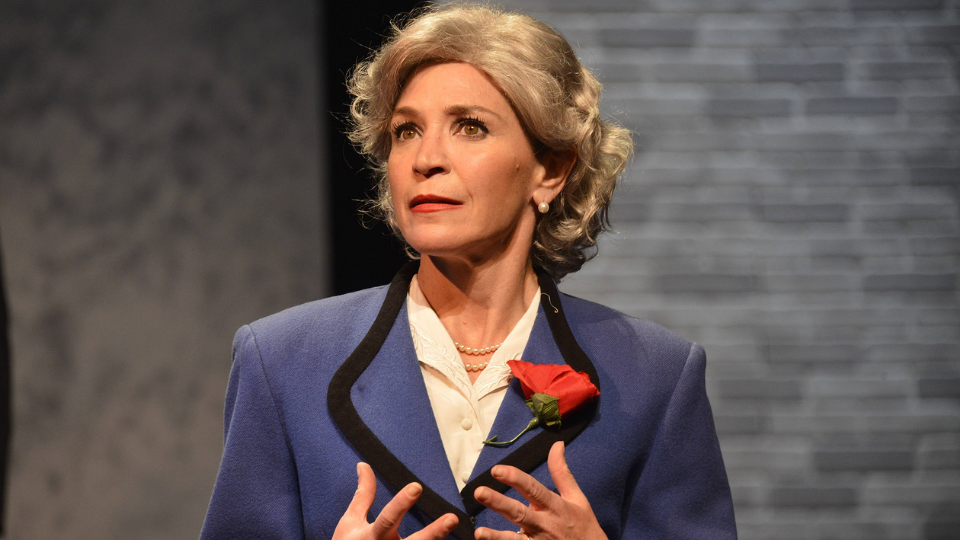
But in playwright Joe DiPietro’s Conscience, the hero—or rather, heroine—is a real-life historical figure who truly did do something rather heroic: Senator Margaret Chase Smith (Sharon Gardner). Maine and senators have been much in the news lately, but in 1950 Smith was the only woman serving in the U.S. Senate. And she intrepidly used that seat and stature to challenge America’s Cold War redbaiter in chief: Senator Joe McCarthy (Jon Root), who, starting on Feb. 9, 1950, never saw a bed a “Red” wasn’t hiding under.
This is the stuff of high tragedy, and International City Theatre’s production of DiPietro’s four-hander powerfully dramatizes history while also making the personal political, with touches of humor in a highly entertaining retelling of true-life events worthy of the ancient Greek bards.
In Conscience, as reelection nears, the junior senator for Wisconsin is keenly aware of his undistinguished legislative record (and forged wartime record as the supposed “Tail Gunner Joe”), and hits upon the subject that will propel him into the annals of infamy. At his Feb. 9, 1950 speech in Wheeling, West Virginia, McCarthy strays from his originally prepared remarks to launch into a bombastic, militaristic, anti-communist jeremiad that strikes a receptive nerve during the Red Scare. McCarthy claimed: “[T]he State Department, which is one of the most important government departments, is thoroughly infested with Communists. I have in my hand 57 cases of individuals who would appear to be either card-carrying members or certainly loyal to the Communist Party…”
There is dispute over the exact number of pro-Communist State Department functionaries that McCarthy alleged—Conscience puts the names on the purported list in his hand at “205.” In any case, McCarthy skyrockets from an obscure backbencher to such a prominent politician that his name is given to an entire period and authoritarian style: “The McCarthy era,” and “McCarthyism.”
At first, Senator Smith is impressed by her upper chamber GOP colleague, but when Joe does not provide proof of his accusations, she leads the charge against McCarthy’s reckless campaign of smearing and slandering without having the evidence to back up his wild, if headline-generating, charges. Smith finds McCarthy’s Wheeling raving to be too, shall we say, “freewheeling” when it comes to a little thing called “truth.”
On June 1, 1950, Senator Smith rather valiantly stepped up to the plate and made her own speech on the Senate floor, challenging McCarthy and his brutal, tactless tactics, earning her a lofty perch in the pantheon of fair-play, liberty-loving people. In her 15-minute address originally endorsed by six other Republicans, Smith proclaimed:
“The United States Senate has long enjoyed worldwide respect as the greatest deliberative body in the world. But recently that deliberative character has too often been debased to the level of a forum of hate and character assassination sheltered by the shield of congressional immunity. It is ironical that we senators can, in debate in the Senate, directly or indirectly, by any form of words, impute to any American who is not a senator any conduct or motive unworthy or unbecoming an American, and without that non-senator American having any legal redress against us… [T]he Senate has been made a publicity platform for irresponsible sensationalism. I am not proud of the reckless abandon in which unproved charges have been hurled… It is high time that we all stopped being tools and victims of totalitarian techniques – techniques that, if continued here unchecked, will surely end what we have come to cherish as the American way of life.”
In her powerful broadside, Smith went on to assert: “Those of us who shout the loudest about Americanism in making character assassinations are all too frequently those who, by our own words and acts, ignore some of the basic principles of Americanism. The right to criticize. The right to hold unpopular beliefs. The right to protest. The right of independent thought.”
Smith’s sermon on the Senate floor is called “Declaration of Conscience,” from which DiPietro presumably derived the title for his two-act play. Her no-holds-barred denunciation of McCarthy is especially notable, as it preceded Edward R. Murrow’s legendary programs critiquing Wisconsin’s junior senator on CBS-TV’s See It Now by almost four years. I know a lot about that because Murrow’s courage to take on a tyrant via television inspired my father to name me after the acclaimed newsman, and his producer, Fred Friendly, once told me: “You’re the only journalist in America named after Edward R. Murrow.” But I knew little about Senator Smith— that is, until I saw Conscience.
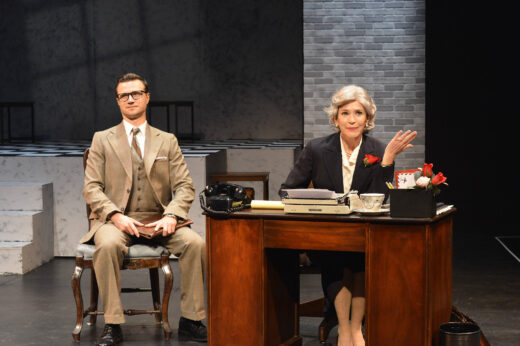
DiPietro’s tour de force, however, is far more than just a history lesson. It is a rip-roaring work of entertainment with laughs, as well as gripping moments of outrage and sorrow. And instead of being ancient history, Conscience is very much of the moment. Sharon Gardner (her credits include NCIS and Modern Family), who dons a grey-haired wig in order to portray Smith, pointed out to me at the post-premiere reception at Long Beach’s L’Opera Italian restaurant that DiPietro wrote his excoriating takedown of McCarthy circa 2019, and thus the play is as much about Trump as it is about McCarthy. Like Eric Bentley’s Are You Now or Have You Ever Been verbatim play using transcripts from the HUAC hearings of noted actors interrogated by congressional inquisitors, which was recently revived on the New York stage, ICT’s Artistic Director/director Caryn Desai brings Conscience back to the boards at a very opportune time full of subtext and meaning for our own beleaguered age.
Conscience has many topical references contemporary theatergoers will find resonant. McCarthy’s assault on the State Department is reminiscent of Trump’s frequent lambasting of “the deep state.” The drama’s dialogue insists that Republican senators hate McCarthy, but don’t speak up because they are terrified of retribution—in today’s public discourse, this is often said of Trump, too. In Conscience Smith, fulminates against McCarthy as being “stupid”—the same word Chris Hayes used to describe Trump on his MS NOW cable news show after the president “renamed” Lake Ontario to “Lake America” (talk about “naming names”!). And like Joe McCarthy, Trump frequently smears opponents and publicly contends things that have no basis in reality.
What’s missing from DiPietro’s play is the most direct link between Joseph McCarthy and Donald Trump: Roy Cohn, who parlayed the part he played in prosecuting and then electrocuting the so-called “atomic spies” the Rosenbergs into becoming the chief counsel to the Senate’s Permanent Subcommittee on Investigations chaired by McCarthy. After McCarthy’s fall from grace, Cohn went on to become Trump’s consigliere, his attorney and mentor, although like Murrow, who played a pivotal role in McCarthy’s downfall, Cohn goes unmentioned in the play. Of course, you can’t cover everything in a 150-ish minute production, but DiPietro did somehow manage to work a passing reference to Nixon into the dialogue.
Part of Smith’s “Declaration” oration is strongly, sonorously delivered by Gardner, who convincingly portrays the senator from Maine. She is the production’s moral and artistic pillar. Gardner told me that as part of her intensive research for her role, she actually went to Maine to imbue herself in all things, shall we say, “Smith-sonian,” and her immersion clearly pays off with a pitch-perfect performance that always rings true.
George Clooney has said that when he directed 2005’s Good Night, and Good Luck about the Murrow-McCarthy confrontation, he decided that only the preternaturally smarmy Joe McCarthy could play Joe McCarthy, so the senator appears in archival clips intercut with the rest of the cast, depicted by actors (onscreen, David Straitharn played Murrow, and in 2025, when Clooney adapted Good Night, and Good Luck for Broadway, Clooney himself portrayed my namesake).
Be that as it may, Jon Root, who has appeared in comedies onstage and onscreen, including Avenue Q and Brooklyn 9-9, injects a note of levity into his role. In doing so, although he doesn’t play McCarthy for laughs per se, he does expose the senator’s essential buffoonery (another attribute Joe has in common with The Donald).
In Conscience, the personal becomes most deeply political with the senators’ staffers. Hollis Dohr plays Jean Kerr, McCarthy’s secretary whose “fanny” he repeatedly pats—and then some. She gives McCarthy the validation he needs, while Kerr hitches her wagon to McCarthy, the rising star of right-wing politics, to advance herself.
Dylan C. Wittrock depicts Smith’s “Man Friday” William Lewis, a much younger political whiz kid who helps shape the Maine senator’s legislative and ethical agendas. The play’s best scene occurs in Act Two between Smith and Lewis. As is his wont, smear-meister McCarthy has uncovered (alleged) dirt on both of them, which he threatens to publicly expose. Of course, McCarthy also has his own fatal flaws, which eventually consume and overrun Tail Gunner Joe.
In addition to demagoguery, Conscience also deals with taboo topics (particularly back then in the Leave It to Beaver 1950s): Homophobia; infidelity; alcoholism; #MeToo power discrepancies in relationships; intergenerational romances; as well as feminism. At the heart of McCarthyism is fanatical anti-communism, and at one point Smith, who is bullish—if not hawkish on U.S. national defense—confesses that while she shares McCarthy’s policies, she despises his “methods.” At the end she points out that whether there were 57 or 205 or however many names were on McCarthy’s bogus list, he never convicted a single Communist.
But this raises an important point: McCarthyism is often depicted as baseless accusations run amok, tainting “innocent” people, accusing them of being “commies.” However, the CPUSA was often the tip of the spear in the struggles for civil rights, unionization, anti-fascism, women’s equality, New Deal programs, and more. During the entire Red Scare, the Communist Party USA was never outlawed. People had a legal, constitutional, and human right to join the Communist Party. Communists, too, had the right to enjoy those “Basic Principles” Smith exalted.
McCarthy’s fanatical witch-hunt never convicted a single “Communist” (real or imagined) of espionage, sabotage or subversion. In general, their real “crime” was supporting viewpoints which the government and powers-that-be disagreed with and disapproved of—which is a violation of the First Amendment’s sacrosanct guarantee of the right to freedom of speech.
Having said that, the must-see Conscience is an important work of political art with artful performances from an ensemble adroitly directed by the keen-eyed Caryn Desai. As the woman from Maine who stood up to the despotic Joe McCarthy, Sharon Gardner anchors the cast with an awards-worthy portrait. Hopefully Broadway/Off-Broadway and regional theaters will also revive this all-too-timely work, and filmmakers will consider making a film version of this clarion call against tyranny. Conscience is live theater at its best: Imparting consciousness and ethical aesthetics while chronicling yesterday in order to illumine today in a highly entertaining way that may make you laugh and cry—and, perchance, to dream and to take action.
Conscience is being performed Thursdays, Fridays, and Saturdays at 7:30 p.m., and Sundays at 2:00 p.m. through Sept. 13 at International City Theatre, Long Beach Convention & Entertainment Center, 330 East Seaside Way, Long Beach, CA 90802. Info can be found here or call (562)436-4610.
We hope you appreciated this article. At People’s World, we believe news and information should be free and accessible to all, but we need your help. Our journalism is free of corporate influence and paywalls because we are totally reader-supported. Only you, our readers and supporters, make this possible. If you enjoy reading People’s World and the stories we bring you, please support our work by donating or becoming a monthly sustainer today. Thank you!
CONTRIBUTOR




MOST POPULAR TODAY

Nurse faces federal charges for helping patient escape ICE custody


Communists and allies fight back after 130 million voters purged in India

As Israeli lawmaker advocates rape of Palestinians, U.N. report details detainee torture

Trump administration guts Endangered Species Act, nature advocates fight back