MINNEAPOLIS—Intense pressure from the Trump administration and consolidation of mass media ownership into “four or five” newspaper chains—as some owners, in pursuit of profits and permissions, play along with Trump—poses a big threat to independent news in the U.S., NewsGuild President Jon Schleuss says.
In an exclusive interview with People’s World, Schleuss, whose rapidly growing union has campaigned for years to “Save Local News!” added that not just journalists, but readers and voters are the victims of such pressure. That pressure, he said, robs journalists and the public of the protection they need to hold government and business accountable.
“They work in a double symbiosis,” Schleuss says of Trump and the chains, particularly the billionaire owners of the news organizations.
Meanwhile, “The chains are continuing to self-destruct because of bad management, while the need for local news coverage” and the accountability it demands from both government and business “is higher than ever,” Schleuss says.
In the last several decades, the mainstream print media has consolidated into two big chains listed on securities exchanges, McClatchy and Gannett, and a third, Tribune, owned by the private venture capital fund Alden Global Capital. Two smaller chains—including one non-profit group—own other papers.
Schleuss has nicknamed Alden “vulture capital.” It swoops in on distressed papers, buys them, cuts their staff in half or more, eliminates coverage, and leaves ruined families and jobless workers. It also sells off valuable real estate and then pockets all the proceeds from those moves.
Sometimes Alden cuts publication to electronic-only, or shuts the paper completely, leaving “news deserts” to be filled by online feeds with ideological slants.
In more than a dozen cases, including at the now Alden-owned Chicago Tribune and at local papers in Florida and Texas, news staffs resisted and moved to preserve their independence and rights to report by unionizing with the NewsGuild. As a result, it’s been one of the fastest-growing unions in the AFL-CIO.
But even that’s not enough to completely combat the threat, so Schleuss talks up other ideas on how to battle the combo of Trump and consolidation.
“Newsrooms need to be independent from the federal government,” Schleuss says. “When the federal government or the president sues a news organization, that’s illegal and inappropriate.
“We’re trying to get news organizations not to capitulate.”
Prime among the counter-moves Schleuss talks up: Further unionization, with news staffs turning to the Guild, a very independent sector of the Communications Workers of America, for the protection of a union contract. “In a union newsroom, you have the right to speak up and prevent AI (artificial intelligence) slop in your news pages,” he points out. There are also grievance procedures designed to prevent arbitrary firings. When those occur, the Guild goes to bat for the staffer.
And AI slop led to at least one recent Guild win. The seven staffers at the Centre Daily Times in Pennsylvania signed union cards and got voluntary recognition from their McClatchy chain bosses, who had put their bylines on AI-generated stories. The larger unionized staff at Politico, in D.C., won a ban on unchecked “AI slop,” too.
“And we can hold the boss accountable, too, in court,” Schleuss adds. The Guild-unionized staff of the now-shuttered Pittsburgh Post-Gazette did that, through a first-time-ever NLRB section 10-e injunction, reserved for unusual circumstances—such as a News Guild unfair labor practices strike that lasted almost three years.
Another way: Convincing non-profit organizations, including union consortiums, to buy local media.
Non-profit purchases have occurred in Salt Lake City, with the Deseret News, at both the Philadelphia Inquirer and the Philadelphia Daily News—under the same owner—and twice, at the Chicago Sun-Times, among others.
The Chicago Federation of Labor was among the investors who bought the Guild-unionized paper out of bankruptcy. When too much red ink gushed, due to loss of print ads to digital, the investor group sold the paper for a token amount (plus assumption of debts) to non-profit public radio station WBEZ.
It’s also occurred in Seattle and in Portland, Ore., Schleuss notes. The non-profit Noisy Creek Group bought the cities’ alternative newspapers, the Stranger in Seattle and the Portland Mercury, last year.
Big news chain owners, more interested in profits than in people, have cut local newsrooms to the bone, depriving readers and citizens of local coverage and the ability to hold local governments accountable for their actions.
A typical example is in Middletown, N.Y., where the Gannett-owned Times Herald Record now attempts to cover three rapidly growing mid-Hudson Valley counties with a total staff of four, plus wire services. In its heyday, 40 years ago under the smaller, family-owned Ottaway chain, the paper’s sports desk alone had eight staffers. There were four copy editors and 20 reporters, including those in now-shut outlying bureaus.
Even larger papers have had to cut back. The Minneapolis Star-Tribune, available to AFL-CIO convention attendees in the Twin Cities, is unionized, as is the St. Paul Pioneer Press. But the Star–Tribune’s daily deadlines are early, because it’s actually printed at a union shop in Des Moines, Iowa, more than three hours away. There are no more large union printers in Minnesota.
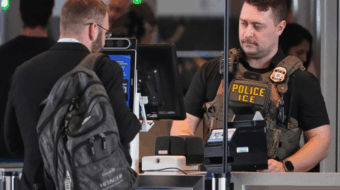
Despite that, local “journalists are witnesses” in cases where the national media often aren’t. As an example, Schleuss praised the Star-Tribune and the Pioneer Press for their fearless coverage of Trump’s Immigration and Customs Enforcement (ICE) agents’ brutal and violent conduct during Operation Metro Surge, the anti-immigrant sweeps through the Twin Cities, including photos.
Members of the papers’ photography staff “were shooting photos” of the scene where a Trump Border Patrol agent first disarmed Veterans Administration nurse Alex Pretti, a Government Employees (AFGE) member, then killed him with seven bullets in his back.
The photographers, Schleuss added, “wore dark blue vests labeled ‘PRESS’ and gas masks, but the masks don’t work in 20 degrees below zero weather.” One agent “shot a Pioneer Press photographer in the chest with a tear gas cannister. Ten minutes later, he was back at work.”
Schleiss’s point is that chains don’t have that commitment to local news. And it took the NewsGuild to sue the Trump government for ICE attacks on newspeople in Los Angeles, Chicago, and the Twin Cities during the agents’ violent repression and sweeps in all three. The Chicago and L.A. Guilds won court rulings against the Trump government, Schleuss noted.
The National Association of Broadcast Employees and Technicians/CWA local in Chicago joined that city’s Guild in their case. The Illinois Publishers Association—the bosses—pulled out, leading its executive director to resign in protest.
On the broadcast side of the news, the 2025 $8 billion merger of Paramount, which owns CBS, with Skydance Media brought Trump donor David Ellison to the fore of the combined company. “CBS had a settlement” with Trump over one of his lawsuits, Schleuss comments. “And then there was the purchase.”
It’s also produced a multimillion-dollar payment to Trump to stay out of the merger talks, and the hiring of right-wing editor Bari Weiss for CBS News. That wasn’t all.
Weiss initially killed a 60 Minutes investigative story about dangerous conditions at the largest ICE detention camp in East Texas, allegedly because of a lack of Trump White House input. Staffers complained loudly. Weiss, whose background was as a conservative podcaster and commentator, retaliated by firing veteran and noted 60 Minutes correspondent Scott Pelley.
Before he was canned, Pelley told Weiss to her face during a tense staff meeting that she was “murdering” 60 Minutes.
Even before that, Weiss “directed coverage of the killing” of the other Minnesota citizen, Renee Good, to show her driving her sport utility vehicle towards the ICE agents, not trying to back out of a parking space, as video showed, Schleuss noted.
That’s not the first time a print owner bowed to Trump. When the Jan. 6, 2021, MAGA invasion of the U.S. Capitol occurred, the unionized Pittsburgh Post-Gazette staff wrote it straight. The right-wing Block brothers, the paper’s owners, had their editor rewrite the stories to take away blame from the invaders. Under the union contract, the paper’s staff conducted a byline strike.
And when multibillionaire Jeff Bezos, owner of the Washington Post, spiked an endorsement editorial for Democratic presidential nominee Kamala Harris in 2024, he provoked a staff uproar at the Guild-unionized paper. When Bezos later followed by decreeing the Post op-ed pages would run only columns by conservative, pro-business, or libertarian writers, resignations followed. Bezos has since fired a third of the paper’s remaining staff.
We hope you appreciated this article. At People’s World, we believe news and information should be free and accessible to all, but we need your help. Our journalism is free of corporate influence and paywalls because we are totally reader-supported. Only you, our readers and supporters, make this possible. If you enjoy reading People’s World and the stories we bring you, please support our work by donating or becoming a monthly sustainer today. Thank you!
CONTRIBUTOR