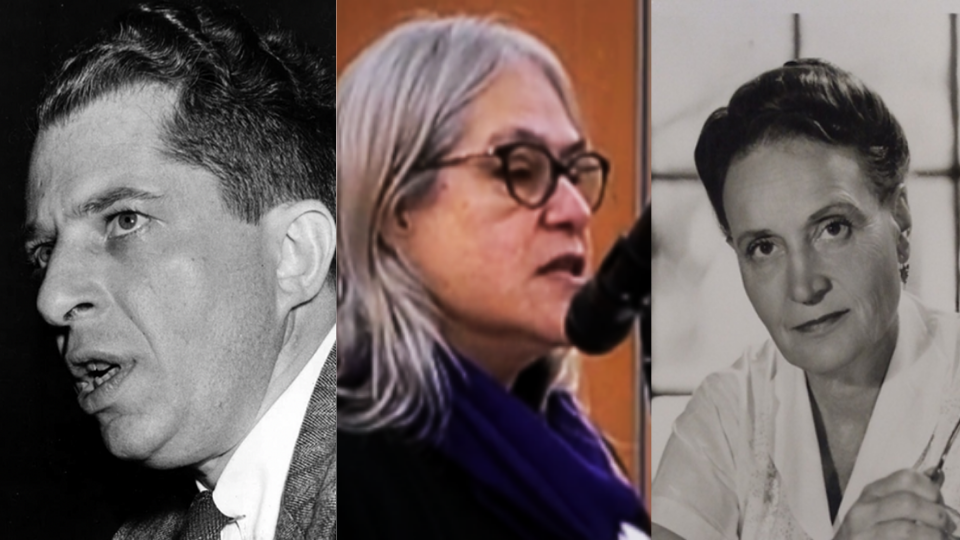
AKRON, Ohio—The spirit of Albert Maltz filled the Jacobsen Common Room at the University of Akron on October 30. Maltz, the most talented writer of the famed “Hollywood Ten,” went to prison for his beliefs in 1950 and spent more years on the Cold War blacklist than any other banned artist. Though he died in 1985, he lived again through the impassioned speaking voice of his granddaughter, the San Francisco-based activist Mira Larkin. Before an audience of students and faculty, Ms. Larkin honored the memory of her grandfather and also shared her own journey, which was sometimes traumatic. As she spoke, it became clear that her family’s Cold War ordeal had lessons for today.
The speech was part of the semester-long undergraduate honors course, “Only Victims: The Hollywood Blacklist and the Bill of Rights,” taught by Dr. Patrick Chura.
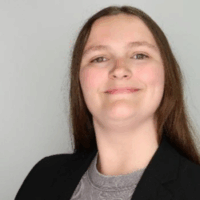
At 6:30 p.m., Professor Chura introduced Larkin and mentioned that she had worked as an actress in independent films. Then she stood at the podium and showed us why. For the first fifteen minutes, she channeled her grandfather by re-enacting the full, defiant “testament” that Albert Maltz made on October 28, 1947, before the House Un-American Activities Committee chaired by J. Parnell Thomas.
In our course readings, this speech had been described by a film historian as “a righteous jeremiad spat right into the faces of the inquisitors.” Mira did justice to its flaming rhetoric:
“I am an American and I believe there is no more proud word in the vocabulary of man.
Now, at the age of thirty-nine, I am commanded to appear before the House Committee on Un-American activities.
I maintain that this is an evil and vicious procedure, that it is legally unjust and morally indecent—and that it places in danger every other American.
I assert that not only the conduct of this Committee, but its very existence, are a subversion of the Bill of Rights. . . . I would rather die than be a shabby American, groveling before men whose names are Thomas and Rankin, but who now carry out activities in America like those in Germany by Goebbels and Himmler.
The American people are going to have to choose between the Bill of Rights and the Thomas Committee. They cannot have both. One or the other must be abolished in the immediate future.”
Maltz’s speech was an apt prelude to Larkin’s own testimony, delivered under the title, “Still Burning: Intergenerational Trauma and the Cold War Hollywood Blacklist.” Larkin delved into the dual legacy she had inherited from political persecution. On one side of the emotional ledger was a deep wound passed down through generations; on the other was an equally deep calling to fight for social justice.
If the maltreatment of Margaret (Albert’s former wife and Larkin’s grandmother) was politically bigoted and sexist, the long reach of the blacklist was also devastating to the Maltz children. Fear of a second incarceration (a fear justified by the 1950 McCarran Act and, later, the Communist Control Act of 1954) sent the family into exile and kept them in Mexico for more than a decade. It was there that both Peter and Katherine (Larkin’s mother) developed severe behavioral issues stemming from what Mira termed “the feeling of terror, the feeling of not belonging.” Additionally, it led to the heartbreaking divorce of Albert and Margaret in 1963, as well as to Margaret’s worsening health and early death in 1967.
When Katherine was injured in a car accident in the early 1970s, Mira was left at a young age in the care of her uncle Peter. In this environment, dominated by her caretaker’s unchecked feelings of rage, Mira imbibed the same fears that plagued her parents and grandparents. During her heartfelt lecture in Akron, she described her uncle’s anger, the slamming of doors that echoed through his empty home, where she watched through the eyes of a child as the blacklist’s legacy finally broke him.
Nevertheless, Mira spoke bravely, detailing unceasing family tensions that are actually best described as long-term political fallout—the complex heritage of Albert Maltz’s famously defiant but doomed political stance. This was intergenerational trauma in its rawest form, the silent, daily cost of an ideological battle fought before she was born.
Yet, from this same soil of hardship grew a shocking and powerful counter-legacy, one built around an urgent fight for political progress. As Mira explained, the blacklist not only bred fear but also forged a fierce and unwavering commitment to social justice.
Larkin shared a pivotal story about her mother, perhaps the single person most directly shaped by her family’s trauma. Following the assassination of Martin Luther King, Jr. in 1968, Katherine Maltz moved to San Francisco for the explicit purpose of fighting for King’s racial justice legacy. It was there, among active members of the Black Panther Party, that she stoked her inner fire and began passionate work for civil rights and the establishment of ethnic and women’s studies programs in local universities.
Larkin discovered her own fire in the early 1980s, when she protested much like her mother once had. “I carried the memories of Albert’s exile, Margaret’s defiance, Katherine’s fire, and the legacy that their fight had made room for, in me,” she said.
The activist went on to articulate a deeply “personal” list of the blacklist’s lessons:
“This is what happens when power needs a scapegoat, when cruelty becomes policy, when silence becomes complicity. The echo finds its way home. The trauma never left us; it just changed its shape. Different shape, same wound.”
Ultimately, Mira Larkin’s inheritance from Albert, Margaret, and the Second Red Scare is not just a burden to be endured, but one to be mastered. As she explained, “Now the fire burns inside of me, but I decide how it burns.”
The visit and its oratory, made possible by a University of Akron grant, were an essential component of our semester-long course, which framed the repression of 1947-1960 as a crucial lens for examining our own modern era of censorship and ideological conflict. Our classwork, from transcribing hundreds of pages of prison letters between Albert and Margaret to reading their political speeches, analyzing Maltz’s screenplays, and studying two of his novels, prepared us to appreciate a period of twentieth-century history that is often misunderstood or forgotten.
Hearing about Cold War-era political casualties in person, from an ancillary casualty persecuted by proxy due to her family bonds, was moving. The term “Hollywood Ten” was no longer a cryptic paragraph in a history book; it was a living and breathing argument for liberty that filled that room in Akron, its relevance to the present undiminished nearly eighty years later.
The professional erasure of Maltz’s name paralleled his family’s personal erasure from public life. The practice of “fronting” Albert’s films and other publications mirrored the concealment forced upon every member of the blacklist. For Maltz, it meant watching his profound talent and artistic labor, his cinematic testament against oppression, be both dispossessed and misattributed. For his family, this Cold War practice served as a reminder that their name was deemed a contaminant, something to be scrubbed from the very culture that had once celebrated his work.
Assaults on the legacies of artists were not an isolated injustice but a cornerstone of the Cold War campaign of ideological control. The blacklist was only one of many tools designed to contain “subversive” ideas by any means necessary. Our undergraduate course framed the period as one of profound “fear and polarization,” a time when social discourse was weaponized. To be accused was to be isolated; to defend the accused was to risk sharing their fate. The “front” was the professional incarnation of that isolation.
The blacklist’s calculated erasure sought to eliminate not just careers but an ongoing moral and artistic heritage. It is that very heritage, however, that Mira Larkin reclaimed for us through her testimony. She demonstrated that while a name can be removed from a film’s credits, the fire of its truth is harder to extinguish.
While Albert Maltz provided the historical paradigm, Mira Larkin’s story was the tangible motor-power and emotional weight. What the combination said to us was that seemingly distant personal trauma is a key to understanding current history and current threats to free speech.
Perhaps the most direct parallel is in the realm of censorship, where the blacklist era suppressed and blotted out what was deemed “un-American.” The same battles are being fought today on school boards, on university campuses, and in libraries.
Florida’s “Stop WOKE Act” and Ohio’s SB-1 law, for example, move beyond targeting books to restricting speech and banning references to DEI initiatives—both done while enforcing a catch-all “Neutrality on Controversial Topics” that essentially prevents teachers from stating uncomfortable truths. This is not the Hollywood blacklist of the 1950s, but a modern legislative blacklist with the same goal: policing thought through the threat of personal destruction.
The blacklist era should not be forgotten but reflected upon. Mira Larkin is an eloquent spokesperson for the period’s defiant, resilient spirit, its fire for justice, passed down over decades but still burning brightly.
We hope you appreciated this article. At People’s World, we believe news and information should be free and accessible to all, but we need your help. Our journalism is free of corporate influence and paywalls because we are totally reader-supported. Only you, our readers and supporters, make this possible. If you enjoy reading People’s World and the stories we bring you, please support our work by donating or becoming a monthly sustainer today.
CONTRIBUTOR