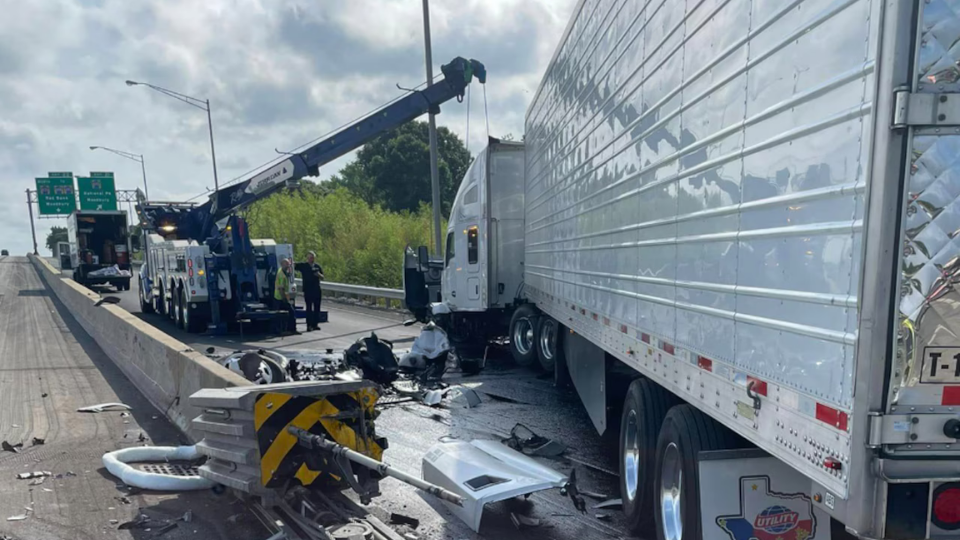
WASHINGTON—Deregulation of the trucking industry almost 50 years ago produced a Wild West of fly-by-night operators, declining wages and abominable working conditions—such as workers driving too many hours on too little sleep—and scattershot service to shippers, the Teamsters say in a long analysis of the history of the industry. It’s printed in the latest issue of the union’s magazine.
And the deregulatory saga is relevant today, and not just in trucking, though the union doesn’t say so. That’s because the GOP regime of anti-union President Donald Trump has embarked on deregulation with a vengeance since he returned to the White House on Jan. 20, 2025.
Trump issued an executive order mandating that federal agencies kill 10 regulations for every one they promulgate. And his firing of 317,000-and-counting federal workers has left many agencies, including the Labor Department and the EPA, with too few people to enforce what rules remain.
And the heads of DOL and the environmental agency—former Trump Labor Secretary Lori Chavez-DeRemer, the daughter of a Teamster, and EPA chief Lee Zeldin, a former Long Island Republican congressman, respectively—have slashed with zeal at both protective rules and enforcement staffs.
Which is, it goes without saying, exactly what the corporate CEOs want in their quest for profits above all. Working people paid, are paying, and will pay the price in the future, the Teamsters contend.
So the Teamsters set out to remind everyone of the history of deregulating trucking, not to mention airlines, food firms, Ma Bell, grocery chains, broadcast media, banking, health insurance, and more.
In a section of the long analysis entitled “Paved with good intentions,” the Teamsters wrote: “Policymakers began abandoning the muscular regulatory approach” to trucking, enacted during the New Deal. Instead, lawmakers and presidents “were in favor of markets and deregulation.”
“Frantically searching for scapegoats” to break the combination of inflation and unemployment, “both parties agreed…regulation was the problem,” the union reported. “A bipartisan commission began systematically removing the legal barriers that had protected workers and consumers in sector after sector for decades.”
At the time, the late 1970s under the Carter administration, not even progressives—much less “new Democrats” such as Jimmy Carter and, later, Bill Clinton—listened. Even Sen. Edward M. Kennedy, D-Mass., by then the liberal leader and most effective legislator in Congress, heeded the siren song of deregulation. Carter signed Kennedy’s airline deregulation law in 1978.
“After years of effort by Ted and his Senate Judiciary Committee counsel, Stephen Breyer,”—the future Supreme Court Justice—“Congress passed legislation which would deregulate the airline industry, which would drive down fares with increased competition,” the staff of the Boston Globe wrote in The Last Lion, their exhaustive biography of Kennedy.
Trucking deregulation followed two years later, also under Carter. The result, the Teamsters said, was chaos. “Anyone with a commercial driver’s license and enough money for a truck could haul nearly anything, anywhere.
“It is difficult to overstate how disastrous this was for the Teamsters. The union lost a million members” in the ensuing decade.
Carter promised “new jobs for truckers” from deregulation. Didn’t happen, the union says.
The same scenario played out elsewhere as deregulation spread. Legacy airlines such as Pan Am, Eastern, and TWA collapsed, throwing tens of thousands of people out of work. Savings and loans were deregulated, thanks to Sen. Phil Gramm, R-Texas. They got overextended and tanked, taking people’s mortgages with them.
Ma Bell was split into eight regional “Baby Bell” companies, leaving the Communications Workers having to negotiate with all of them—and with the firms playing the union’s members off one against another as the companies tried ways to cut workers and race to the bottom, and so on.
And, eventually, the Teamster article notes, what happened after all the chaos is consolidation, monopolies, oligopolies, and what experts call “monopsonies.”
A monopsony is a situation where a firm or group of firms—say, Walmart, big grocery chains, and meatpackers—has so much power that they can collude to dictate wages to all their workers, prices to all their customers, and payments, or lack of them, to all their suppliers.
Exhibit A for the Teamsters is trucking. Exhibit A for everyone is the airlines. And the nation’s freight railroads are Exhibit A-2.
“The deck is stacked in a way that makes the roads more dangerous,” another article in the same magazine says. “As experienced drivers retire, the industry is flooded with newcomers.”
Those new drivers are often recruited by “non-union mega-carriers” prospecting for workers in exploitable communities of color. They get little training before receiving their CDL licenses. “They’re enticed with promises of high pay and benefits…then put to work under grueling conditions.”
To those who know U.S. history, that sounds an awful lot like the Robber Barons of the post-Civil War era, including their power to dictate prices, payments to shippers, and workers’ wages. Like those moguls of the 1880s and 1890s, today’s magnates also use their wealth to buy politicians, via campaign contributions and “dark money,” though the Teamsters don’t say so.
There’s a famous Joseph Keppler cartoon of the U.S. Senate of that era. Senators are overshadowed by overweight, bearded men with moneybags for stomachs, wearing top hats and greatcoats. They’re labelled “oil trust,” “copper trust,” “beef trust,” and so on. Think John D. Rockefeller and Standard Oil, or George Pullman, the Pullman Palace Car Company, and his “company town” in what is now Chicago’s far South Side, and you get the idea.
Trucking is down to a handful of large carriers and some less-than-truckload (LTL) carriers, including FedEx Freight (the smaller section of FedEx) and XPO Logistics, which former Trump Postmaster General Louis DeJoy headed for years.
Railroads were deregulated and now feature six big freight lines, with one, Union Pacific, already advertising itself as running from coast to coast. There are only a handful of dominant grocery chains, and almost as few television networks. Pro-Trump mouthpiece Fox leads a few cable TV goliaths
The U.S. has four big dominant airlines, United, Southwest, American, and Delta. Everyone else is a “feeder” airline. One such feeder just declared bankruptcy and shut down, stranding tens of thousands of passengers.
“It doesn’t have to be this way,” the Teamsters declare.
Speaking of trucking, their article adds: “For nearly half a century, oversight by the Interstate Commerce Commission demonstrated that stable, middle-class [truck] driving jobs were not only possible but sustainable.” Communities got guaranteed service by firms which had to prove they had the wherewithal to run their routes and obey the ICC’s rules. Shippers got guaranteed rates and companies got guaranteed profits, all via the ICC.
“Deregulation did not transform trucking into a long-term, more-efficient industry. It traded long-term stability for short-term cost-cutting.” The Teamsters still ink their National Master Freight Agreement with the big long-haul trucking firms, such as ABF Freight and UPS.
“But as a relic of a bygone era, it [the agreement] is proof that a different model once worked, still works, and can work again.”
The revolutionary tradition that birthed the Declaration of Independence also produced a free press as a democratic necessity—from the radical pamphlets of Thomas Paine to the abolitionist papers of Frederick Douglass to the labor press of the 20th century. People’s World, as heir to that tradition, carries the fight forward today against a ruling class that would rather the working class have no press of its own. The free press is the guarantor of moving toward a more perfect democracy, not the “enemy of the people” as the White House says. Please donate to help expand the reach of People’s World.
CONTRIBUTOR