BEIJING—In the latter days of January 1923, the Chinese revolutionary democratic leader Sun Yat-sen issued a joint agreement with the ambassador of the newly established Union of Soviet Socialist Republics. This manifesto marked the beginning of the Nationalist Party’s cooperation with Communists, paving the way for the First United Front in China.
United on the basis of reinvigorating the Chinese nation and beating back imperialist and fascist aggressors, the Communist and Nationalist parties ushered in a brief, but deeply formative, period of cooperation. That alliance—along with the Second United Front against Japanese imperialism—were cooperative interludes falling in the middle of a more than 20-year civil war.
A little over a century later, it appears that those same principles which framed the United Fronts—safeguarding the nation and standing up against imperialism—could be fueling a new convergence of interests between the two former foes.

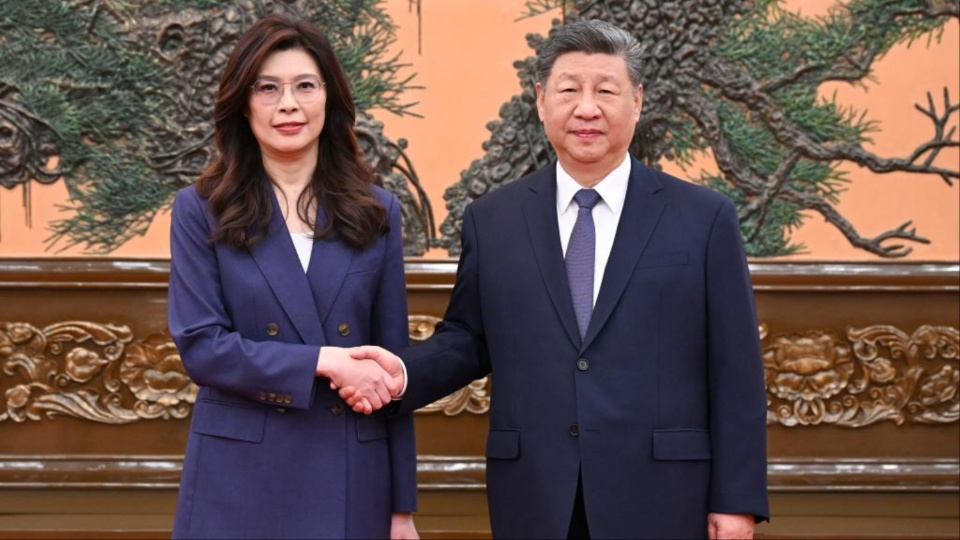
Cheng Li-wun, the recently elected leader of the now Taiwan-based Chinese Nationalist Party (Kuomintang, or KMT), began a five-day visit to the mainland on Tuesday, April 7, following a high-level invitation from Chinese President Xi Jinping, who is also leader of the Communist Party of China (CPC). Her arrival marks the first time in more than a decade that a leader of the KMT, which once engaged in a brutal decades-long civil war against the ruling CPC, has formally visited the mainland.
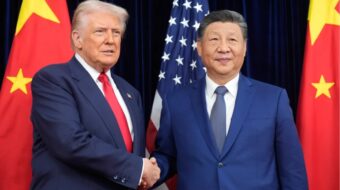
Aside from its high-level nature, the timing of the visit is also noteworthy. It occurred at a critical juncture, when tensions across the Taiwan Strait have been steadily escalating and just ahead of the much-anticipated arrival of embattled U.S. President Donald Trump. He’s expected to undertake his own visit to the mainland next month. Cheng’s arrival also coincided with the 99th anniversary of the historic Shanghai Massacre, a grim episode in which KMT forces brutalized thousands of civilians and suspected communists, underscoring the sordid history between the two parties.
With these facts in mind, many, including Cheng herself, consider her visit as one of peace and reconciliation, with serious implications for Taiwan’s relationship with the mainland.
Indeed, during every step of her visit, the chairperson, who proudly proclaimed, “I am Chinese,” and garnered massive grassroots support from within the KMT, spoke loud and clear of the common grounds between Chinese people on both sides of the Taiwan Strait.
At the Sun Yat-sen Mausoleum in Nanjing, she reflected on the death and legacy of Sun, who is regarded by both the KMT and the CPC as Guofu (Father of the Nation). She then acknowledged the KMT’s early history in searching for China’s future, as well as its historic errors, such as the decades-long White Terror, which claimed the lives of thousands. Particularly well-received was her emphasis on Taiwan’s anti-imperialist history of combating Japanese colonization, notable in light of the China-Japan friction over Taiwan.
The formal meeting with Xi on April 10 sent a similar message: The two party leaders agreed that both Taiwan and the mainland bear a responsibility for the rejuvenation of the Chinese nation, with the 1992 Consensus—the CPC-KMT agreement which opened cross-straits relations—and anti-separatism as the basis of peaceful exchange. The institutionalization of peaceful communication, as well as mutual understanding of the differences in the political system and way of life was called for.
“Hopefully, with the unremitting efforts of our two parties,” Cheng said, “the Taiwan Strait will no longer be a focal point of potential conflict, nor will it become a chessboard for external intervention.”
Her effort was received with enthusiasm, especially from Taiwanese businesspeople and students living on the mainland, who have long felt political pressure from home, as the current government of Taiwan President Lai Ching-te has increased its efforts to cut off cross-strait communication.
As Taiwanese economist and politician Chiu Yi pointed out, “Many broke into tears when Cheng said: ‘You all have endured so much over these years.’” Cheng promised that if the KMT wins the coming elections, she will open a new era for the cross-strait economy, allowing the people of Taiwan to ride the tide of China’s 15th Five-Year Plan.
Despite her ambition, Cheng still faces numerous contradictions back home. Although she took won the KMT leadership election handily, pressure from various factions within the party threaten her with ostracization. The KMT, once an iron-clad ally in the U.S.’ anti-communist Cold War, has long suffered from internal division, with many higher-ups having deep ties with the United States. Hung Hsiu-chu, the last sitting KMT chairperson before Cheng to visit the mainland, was forced to pull out of the 2016 presidential campaign for being “too pro-unification,” and many fear Cheng could face a similar fate.
Simultaneously, the KMT’s modern rival—and governing party in Taiwan—the U.S.-backed Democratic Progressive Party (DPP), seems to be willing to go to any end to consolidate its power. Its recent attempt to pass a new military budget that would include tens of billions of dollars in contracts for the U.S. military-industrial complex, has met with fierce resistance from the KMT so far. In turn, the DPP shifts the blame to Cheng, claiming that her visit to the mainland was evidence of CPC interference in blocking the military budget and threatening legal persecution on Cheng and her colleagues.

Also worth noting is the much-anticipated visit of Trump, who is scheduled to arrive in Beijing in May but has yet to confirm his itinerary. He has already rescheduled once, a move publicly explained by the supposed need to give further attention to the U.S. war on Iran. In light of the developments in the Middle East, some scholars on cross-strait issues speculate that the Trump administration might be planning to eventually abandon Taiwan after draining the island dry through military deals and the forced movement of Taiwan’s chip industry.
For the People’s Republic of China, which is recognized under UN Resolution 2758 as the sole legitimate authority over China, including Taiwan, such a buildup of military force—which it sees as an obvious attempt to foment armed separatism and provoke a conflict—is an unacceptable affront to the nation’s territorial sovereignty.
Faced with the prospect of the DPP turning Taiwan into a proxy for a new Cold War against the Chinese people, is it possible that Cheng and her KMT comrades are giving thought to a new alliance of some kind, a united front, with their old Communist adversaries?
With these contending interests at play, it may very well be that Cheng’s visit marks a new inflection point in the ongoing struggle for China and the world: Will Taiwan become yet another pawn for U.S. imperialism, or will the KMT overcome its history to reforge the anti-fascist legacy of unity and brotherhood established by Sun Yat-sen? Will Cheng, who herself once stood on the side of Taiwan separatism before declaring it a “dead-end” and a “lie,” be able to set a new direction in the region?
We hope you appreciated this article. At People’s World, we believe news and information should be free and accessible to all, but we need your help. Our journalism is free of corporate influence and paywalls because we are totally reader-supported. Only you, our readers and supporters, make this possible. If you enjoy reading People’s World and the stories we bring you, please support our work by donating or becoming a monthly sustainer today. Thank you!
CONTRIBUTOR