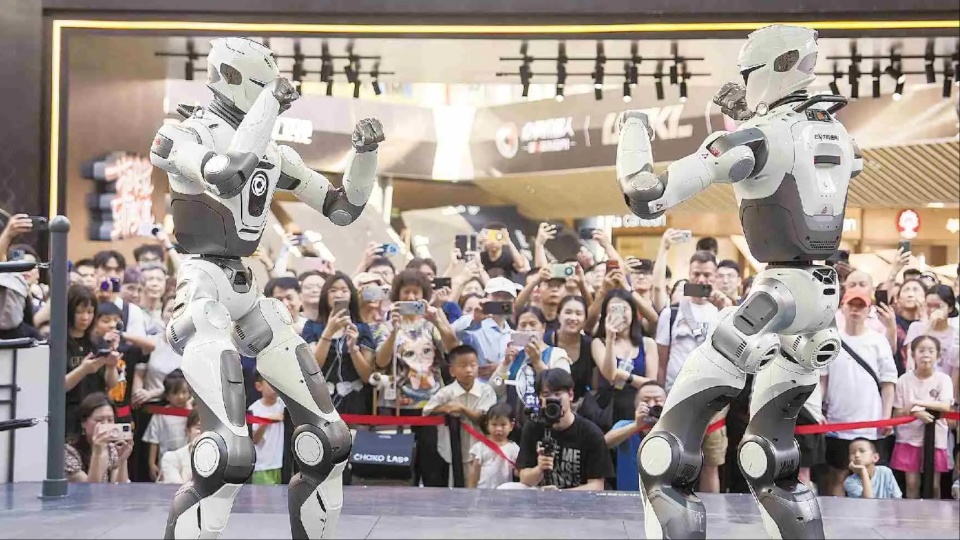
On July 16, China changed the face of combat sports forever with the launch of the Ultimate Robot Knockout Legend, or URKL, the world’s first robot fighting tournament. In Shenzhen, Guangdong province, machines powered by servos, steel armor, and combat algorithms squared off in bouts that quickly went viral.
Footage of the robots Matador and White Eagle trading blows spread fast across the internet. In one unforgettable moment, White Eagle knocked Matador’s head clean off its shoulders, yet Matador kept fighting and absorbing strikes, thanks to backup systems mounted in its torso.
Steel meets algorithm
The launch drew a packed crowd of martial arts fans, students, and working professionals, along with a notable guest: martial arts icon Donnie Yen, star of the critically acclaimed Ip Man franchise. It was, above all, a showcase for a striking blend of ancient tradition and modern robotics.
URKL is scheduled to run through the end of the year, drawing teams from around the world, including two from the United States: the University of California, Berkeley, and Stanford University, both among the tournament’s 32 finalists. Those finalists, who also include teams from Zhejiang and Hong Kong, are now fighting head-to-head for a championship belt and a purse of 10,000,000 yuan, or roughly US$1.48 million.
Martial arts: Sport, spirit, and soul
Martial arts has long been a centerpiece of cultural life across Asia, drawing students from around the world to train with elite fighters, from the Muay Thai gyms of Bangkok to the Shaolin temples in the hills of Henan province. In the world of combat sports, everything is decided on the mat, and the discipline is steeped in honor, tradition, and devotion to the craft.

Tournaments are more than a show for an eager crowd cheering on the skill, power, and discipline of the fighters; they are where legends are made. For the disciplined, martial arts is a way of life, but it is also a path to healing and to overcoming adversity—a dynamic explored everywhere from the Karate Kid franchise and its Netflix sequel, Cobra Kai, to gyms in neighborhoods around the globe.
Many practitioners study it not only to prove themselves as fighters, but for growth. Traditions such as Zen Buddhism, tai chi, and Daoism are inseparable from the martial arts, their meditations woven into combat stances and their breathing exercises used to channel qi, which in Chinese medicine plays as fundamental a role in health as breathing itself.
Mind and body, as the saying goes—and as Bruce Lee made famous—should be like water: soft and yielding, yet hard enough to crush rock and bend steel.
Public opinion
Public opinion on URKL has been sharply divided. Some see a childhood dream come true; others react with shock, even horror. In between are those who see the tournament simply as a vessel for innovation. It’s easy to understand why those inclined toward engineering would find it exhilarating: A real-life echo of Real Steel, Big Hero 6, and BattleBots, offering a new, healthy form of international competition and cooperation.
But flip the coin over, and there’s a more troubling reality. Robots were built, in large part, to assist humanity—a mission that has long included military applications running counter to the goal of putting people first. Calibrating a robot to land a strike with that kind of precision is a remarkable feat of engineering, but if a blow like that ever landed on a person, the results could be fatal.
These fears are not unfounded. Videos have circulated online of personal robots appearing to turn violent. AI and machines don’t have feelings, so any harm they cause is unlikely to be intentional, but that doesn’t erase the physical damage a glitch, or a corrupted line of code, can do.
According to the Guangzhou-based Southern Metropolis Daily, URKL organizers have taken safety seriously. Fights take place inside a cage, with each robot relying on its own processing systems to judge distance and time its strikes. Several emergency shutoffs are positioned around the arena, ready for staff to activate at a moment’s notice. Every robot must pass a rigorous pre-match inspection, and explicit rules forbid dangerous modifications. Safety, organizers say, is paramount, thus freeing everyone else to simply enjoy the fights.
“Certainly, I prefer robots fighting one another, rather than humans doing the same thing, especially for entertainment. From both a technical standpoint and a human one, I’m a sucker for innovation,” Gordon Richiusa said in a statement to People’s World.

Richiusa, a six-decade martial arts veteran and member of the U.S. Black Belt Hall of Fame, reflected on his own experience as a fighter: “I realized how easy it is to injure and perhaps kill another person. I don’t want to be responsible for another’s death or serious injury.”
Humans fighting humans, he continued, “is barbaric and brutal. Perhaps this technology will one day lead us to solving our conflicts without knocking off one another’s heads”—as these early robot combatants, quite literally, did. Richiusa did not attend the event in Shenzhen but was captivated by footage of the fights and glad to share his perspective.
The bigger picture
This tournament was certainly built to be a spectacle, but peel back the layers and it becomes something more: a bellwether, testing both the engineering knowledge of its competitors and our collective willingness to embrace, or resist, a future where we share space with autonomous machines—in our arenas, our workplaces, and beyond.
Martial arts has always been about mastering the self before mastering the opponent, and as robots take to the mat, that lesson still holds. Technology will advance, and is advancing. The question is whether our wisdom advances with it.
We hope you appreciated this article. At People’s World, we believe news and information should be free and accessible to all, but we need your help. Our journalism is free of corporate influence and paywalls because we are totally reader-supported. Only you, our readers and supporters, make this possible. If you enjoy reading People’s World and the stories we bring you, please support our work by donating or becoming a monthly sustainer today. Thank you!
CONTRIBUTOR