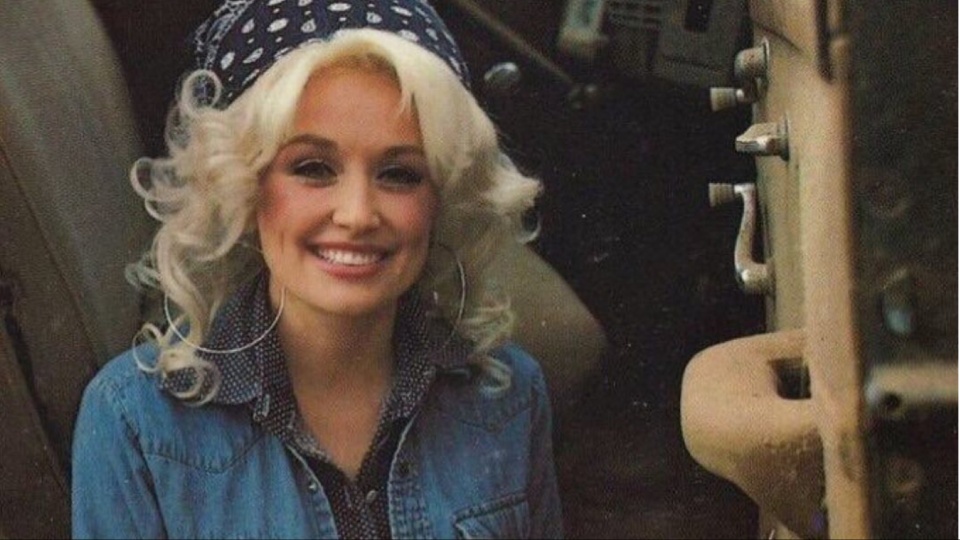
The tributes to Dolly Parton pouring out this week will dwell on her song catalog—“Jolene,” “Coat of Many Colors,” “I Will Always Love You”—and on the causes now attached to her name: her free book program for children and her trailblazing for women in a business men built to keep them out. Those things alone are enough to merit praise, but they aren’t the whole picture. Dolly Parton was a woman who spent six decades in the spotlight but never stopped being what she started out as: working class and loyal to everyone else who was.
Dolly Rebecca Parton was born Jan. 19, 1946, the fourth of 12 children, in a one-room cabin in Sevier County, Tennessee. Her parents sharecropped somebody else’s land before they scraped together enough, years later, to buy a small farm of their own. “We had a lot of stuff that money can’t buy anyhow,” she said of those years, “things like love and kindness and understanding. And we had music.”

Dolly left for Nashville the day after her 1964 high school graduation. She was determined to break into a business where it was hard enough for a woman to get taken seriously as a singer, let alone as a songwriter, but she insisted on being both.
For her entire career, her music was also union-made. She was a member of the American Federation of Musicians Local 257 in Nashville until the very end, filing union contracts on her sessions and tours so her band got the wages that come with a union card. “Before she was an icon, Dolly was a working musician,” AFM President Tino Gagliardi said after her death. Local 257 President Dave Pomeroy put it plainer: “Throughout her 58 years as a proud member in good standing of Local 257, she set the gold standard for supporting her band and fellow musicians.”
That working-class instinct is also the real backstory behind “9 to 5.” The song, and the Jane Fonda film it scored, are remembered now as 1980s workplace comedy, but they grew out of a real class struggle. Fonda, who had the idea for the film, based its story on a Boston clerical workers’ organization called 9to5 that was founded in 1972 by Ellen Cassedy and Karen Nussbaum. It rallied secretaries around pay, harassment, and the daily humiliation of being invisible in their own offices.

9to5’s research exposed banks and insurance companies illegally colluding to fix wages and keep women’s pay low. The group won a 10% raise before growing into SEIU District 925. “Your boss is organized,” Nussbaum liked to say. “You better be organized too.”
Fonda expressed the class consciousness that the film sought to inspire: “What I found was that secretaries know the work they do is important, is skilled, but they also know they’re not treated with respect. They call themselves ‘office wives.’ They have to put gas in the boss’s car, get his coffee, buy the presents for his wife and mistress. So, when we came to do the film, we said…what you have to do is write a screenplay which shows you can run an office without a boss, but you can’t run an office without the secretaries!”

Parton wrote the anthem for the politics and organizing that not only defined the fight for women workers but also captured a truth that all workers know in their heart: “It’s a rich man’s game no matter what they call it, and you spend your life puttin’ money in his wallet.”
On that same LP as “9 to 5,” Parton also covered Woody Guthrie’s “Deportee (Plane Wreck at Los Gatos),” the elegy for 28 Mexican farmworkers killed in a 1948 crash while being flown back across the border, whom media at the time hadn’t even bothered to name, unlike the American crew. “Who are these dear friends all scattered like dry leaves,” she sang, “The radio said they were just deportees.” She staked out a position of support for immigrant workers at a time when politicians were calling for mass deportations, a time much like our own.
She was clear, too, long before it was safe in country music to be so, about where she stood on gay and transgender people. Her 1991 song “Family” put it in a single verse: “Some are preachers, some are gay, some are addicts, drunks and strays, but not a one is turned away when it’s family.” The support went beyond words, though. Her film production company, Sandollar, put up the money behind “Common Threads: Stories from the Quilt,” the 1989 AIDS Memorial Quilt documentary that won the Academy Award while Ronald Reagan’s White House stayed silent on the epidemic.

In 2004, the Ku Klux Klan announced plans to picket Dollywood’s Gay Day; the park’s spokesman said flatly that the demonstrators “will not be allowed on Dollywood property,” and the event went on undisturbed. Parton made her own position explicit a few years later, after a lesbian visitor was asked to turn a marriage equality T-shirt inside out at one of her parks: “Everyone knows of my personal support of the gay and lesbian community,” she said. “Dollywood is a family park and all families are welcome.”
She was secure enough in that support to once enter a Dolly Parton look-alike drag contest at a gay bar in West Hollywood, incognito — and lose. “They just thought I was some little, short gay guy,” she said afterward.
When the fight for marriage equality was raging in the 2000s, she lent her backing in the most Dolly of ways, saying, “Why can’t they be as miserable as us heterosexuals in their marriages?” That was years before the U.S. Supreme Court eventually ruled the religious right’s gay marriage bans unconstitutional.
Her instinct to defend people other folks looked down on showed up on screen, too. When she signed on to play a brothel madam in the 1982 film “The Best Little Whorehouse in Texas,” Parton said she hoped the self-appointed “Moral Majority” would watch it, provocative title and all. “It points a finger at a lot of people, and some of ’em ain’t whores,” she said. “Like people who get fake religion.”

She refused to let the film’s women be treated as a punchline, either: “Prostitutes…are some of the sweetest, most caring people I’ve known because they’ve been through everything,” she said, tracing their circumstances back to broken dreams and abuse rather than to any failure of character. It was the same argument, dressed up as a comedy, that she’d make in earnest for the rest of her life: judge the hypocrites, not the people they judge.
Years later, after a relative and a friend of hers came out as transgender, she wrote the song “Travelin’ Thru” for “Transamerica,” the 2005 film about a trans woman. “I have a friend and a relative who are transgender,” she explained. “I said, ‘I’ll be happy to make a stab at that.’” The song earned her an Oscar nomination.
The same reflex showed up when other people were targeted by those in power. In 2005, with Cat Stevens—by then Yusuf Islam—still barred from the United States after being wrongly flagged on a post-9/11 security watch list, Parton put him on her album “Those Were the Days,” singing “Where Do the Children Play?” as a duet. “He’s a precious man,” she said. “He’s got a lot of bad press lately, but I think he’s out to try to save the world, not destroy it.”
In August 2020, as racist police murder sparked a national uprising that brought millions into the streets, Dolly was asked point-blank about Black Lives Matter and her thoughts on the protests. She didn’t hedge: “Of course Black lives matter. Do we think our little white asses are the only ones that matter? No!” Her support for African American communities stretched back even further.

When she earned $10 million in royalties from Whitney Houston’s 1992 cover of “I Will Always Love You,” Dolly used the money to buy an office complex and strip mall in a Black neighborhood in Nashville and made it into her headquarters, bringing development and jobs to an area overlooked by other investors. “It was mostly just Black families and people that lived around there,” she said. “And I thought, ‘This is the perfect place for me to be, considering it was Whitney.’”
She built all of that—the music empire, the theme park, the 3,000-song catalog—out of a one-room cabin with no electricity, and she never forgot it. What she did with the fame and fortune it bought her was spend it on people who needed the cover more than she did: the musicians in her band, the secretaries who inspired her biggest hit, the gay and trans kids looking for acceptance in a hostile world, the Muslim man barred at the airport, the Black marchers in the summer of 2020. That is a working-class hero’s résumé, and the rest is the soundtrack of her life.
We hope you appreciated this article. At People’s World, we believe news and information should be free and accessible to all, but we need your help. Our journalism is free of corporate influence and paywalls because we are totally reader-supported. Only you, our readers and supporters, make this possible. If you enjoy reading People’s World and the stories we bring you, please support our work by donating or becoming a monthly sustainer today. Thank you!
CONTRIBUTOR